Sitting in a circle with thirteen other children, I was enchanted by my second-grade teacher’s voice. The lilting in her words could draw syllables in the air, forming soft and inviting words. Her vowels were almost guttural, with the end of diphthongs never cut off but sweetly rounded. The way she spoke was exact while relaxed, and when we sat in the circle, I never thought of our relationship as teacher and pupil. She had a way of conversing that vanquished the other thirteen children and the circle. We were never in a classroom, but a small restaurant with white linen table cloths and small flower vases filled with three forget-me-nots, the echelon of 1970s class. Our elbows were on the table, allowing our forearms to support our chins as we whispered the most intimate news. Although shielded by the exaggerated mauve frames of her glasses, her brown eyes signaled I could trust her with my deepest desires. The sotto voce of her voice wrapped around the words, encouraging my honest answer to the simple question: What would you like to be when you grow up? At that moment, I slightly smiled, inhaled deeply, and sighed the secret to my best friend, Ms. Dawn. “I wanna be a dancer on Soul Train.”
In my house, Soul Train was the pinnacle of Saturday morning television. At noon, the television screen went black before a flash lit up the screen, forming the words Soul Train while a descending male voice imitating a train whistle announced the show’s title. Standing before the console television, I slipped and dipped as the animated train buckled and bounced across the screen. The locomotor moved around a cartoon earth and circled a skyline before heading into a tunnel. Emerging from the darkness, the camera panned upward to reveal a mauve background and the large red neon letters spelling SOUL TRAIN. As the lights warmed, silhouettes displayed dancers moving across the stage built to resemble a large city with scaffolding platforms and neon buildings. Mirrored balls projected starlight around the backdrop as the screen illuminated a full studio view. While Don Corneilus welcomed everyone to the hippest trip in America, the dance floor was popping with a hundred people spinning, kicking, swaying, swinging, stomping, and clapping to the bass-heavy theme music. The screen magically split into uneven thirds as the host announced the episode’s musical guest. The bottom two-thirds were reserved for the day’s singers and bands, while the large half of the screen gave top billing to the Soul Train Dancers.
The Soul Train Dancers brought the moves to the music, breathing vivid life into songs mostly confined to the radio. The show’s true stars combined the street’s fresh moves with refined styles of professional dance to electrify a sonic dancefloor. A pas de deux could quickly transform into a single spotlight where dancers crafted a new lexicon of movement that was always clever, comical, expressive, sensuous, strong, and optimistic. The dancers were neither lacking in substance nor style. Soul Train Dancers were the best-dressed people on television. Like their innovative moves, their clothes combined elements of the runway, popular culture, and personal flare. A head-to-toe dark denim jumpsuit would be embroidered with a large white star, cinched with a white belt, and adorned with a magenta scarf and a pinned-on employee nametag. A simple red wrap dress featured seamed hosiery and strategically placed fresh flowers at the waist and in the hair. Couples not only had coordinating outfits but also found ways to make identical ensembles seem desirable. Headbands, scarves, knee-high socks, suits, waistcoats, and sunglasses worked in concert with plaids, stripes, argyles, and polka dots to accentuate body movement. While most dancers were anonymous, several broke through and became fan favorites. Damita Jo, Pat Davis, Rosie Perez, Jody Whatley, Fred Berry, Cheryl Song, Dereck Foxtails, and Louie Car became dance celebrities. They vied for the spotlight, unscrambled letters to reveal the names of creators and activists, and formed rows to emphasize individual talent on the Soul Train Line. The dancers created sixty minutes of weekly syndicated television that was electrifying and aspirational, inviting everyone into the dance. As a seven-year-old white boy in rural North Carolina, I was unaware of the political and social importance of a show made by Black creators featuring Black youth culture, uplifting Black music in a joyful and celebratory fashion. I just knew I wanted to be on that dancefloor.
Dancefloors have been a place of resistance and liberation for many Americans. During the Harlem Renaissance, clubs and speakeasies provided people of various races with places to dance, escaping the recent terrors of WWI. Rent Parties, an underground phenomenon where guests paid a fee that contributed to the monthly rent, supplied Black and white people struggling with the economic landscape with a financial reprise and a diversion from the hardships of daily life. Rent Parties also allowed a venue for alcohol consumption during prohibition. Black Americans stationed in Europe during WWII did not have the social and political restrictions of Jim Crow and introduced dances as a means to escape the constant pressures of bombings. Many aspects of jazz and dance culture from America fueled the swing kids of Germany and Europe, providing a counterpoint to the nationalism and fascism of Nazi Germany. The mid-century birthed the popularity of the block party, unpermitted gatherings where neighborhoods danced and celebrated. By the 1970s, the discothèque provided an escape from economic depression, racial inequality, and heteronormativity. New York’s Paradise Garage and The Loft cultivated spaces where marginalized people found acceptance and freedom. Reaganism, Thatcherism, sexual freedom, Queer Liberation, and Black Joy would be ideas worked out on dance floors. Beyonce’s 2022 Renaissance underscores the decades of escape, pleasure, community, liberation, reclamation, aspiration, and celebration found on the dancefloor.
Aspiration and liberation fueled Oliver Toscani’s work for Benetton. Joining the Italian fashion brand as Art Director in 1982, Toscani was given complete authority to shape the visual images and advertisements of the company. The photographer employed models of various races, ethnicities, and nationalities, producing images much different from the exclusively white campaigns and magazine editorials standard. Depicting people who were typically separated and segregated united in the bright knits of Benetton, Toscani began to caption the images with a simple slogan: Tutti I Colori Del Mondo (All The Colors of the World). The message of global harmony filled magazine ads, catalogs, television commercials, and in-store signage worldwide. The images became so dominant that the phrase “a Benetton ad” entered the lexicon as a way to refer to a diverse group of people. The campaign was so successful that Benetton officially evolved into the United Colors of Benetton in 1989.
At the dawn of 1990, Toscani evolved his approach to all the colors of the world, replacing the global youth with blood vials labeled with the first names of political leaders across the globe. The print ad signaled a change that would remain with United Colors of Benetton throughout the 1990s. The brand was the first to eliminate its products from advertising, replacing sweaters and shirts with a cache of societal phenomena. “New Born Baby” (1991) featured a baby attached to the umbilical cord immediately after birth and was intended to bring attention to life. Outrage was almost unanimous, heavily censoring the ad. During the height of the Gulf War, Toscani produced “Graveyard” (1991), focusing on a war cemetery with numerous identical grave markers. Only one European periodical would run the ad, and it became the target of hundreds of complaints. Toscani would continue to push the brand to use its advertising as a conversation starter about the most critical topics of the day. A trajectory that stayed with the brand for over a decade.
Capital punishment, street violence, terrorism, war, and safe sex were topics synonymous with the United Colors of Benetton in the 90s. “Soldier With A Bone” (1992) used Patrick Robert’s image of a Liberian soldier holding a human thigh bone behind his back, addressing the role of race and colonialism in global conflicts. “The Boat” (1992) thrusted immigration into the spotlight by depicting thousands of Albanians overcrowded on a boat, trying to gain entry into Italy after being rejected from other countries. Therese Fare’s photograph captured a messianic image of AIDS activist David Kirby’s deathbed surrounded by his family at the Ohio State University Hospital in 1990. Toscani used the award-winning photo in “AIDS: David Kirby” (1992), bringing the brutality of the virus into the public eye. Controversy soon followed the brand, with many people from the church house to the state house calling for boycotts and censorship. Toscani defended his approach in a 1991 New York Times interview, explaining that retailers were responsible for contributing to the public good, reaching beyond the sole aim of profit. He explained, “I have found out that advertising is the richest and most powerful medium existing today, so I feel responsible to do more than to say, ‘Our sweater is pretty.’” Toscani, steadfast in his philosophy, propelled the brand into the public eye, connecting with the socially conscious Gen Xers entering college and the workforce. While most Americans couldn’t describe a sweater from the Italian knit maker, Toscani ensured everyone knew the name Benetton.
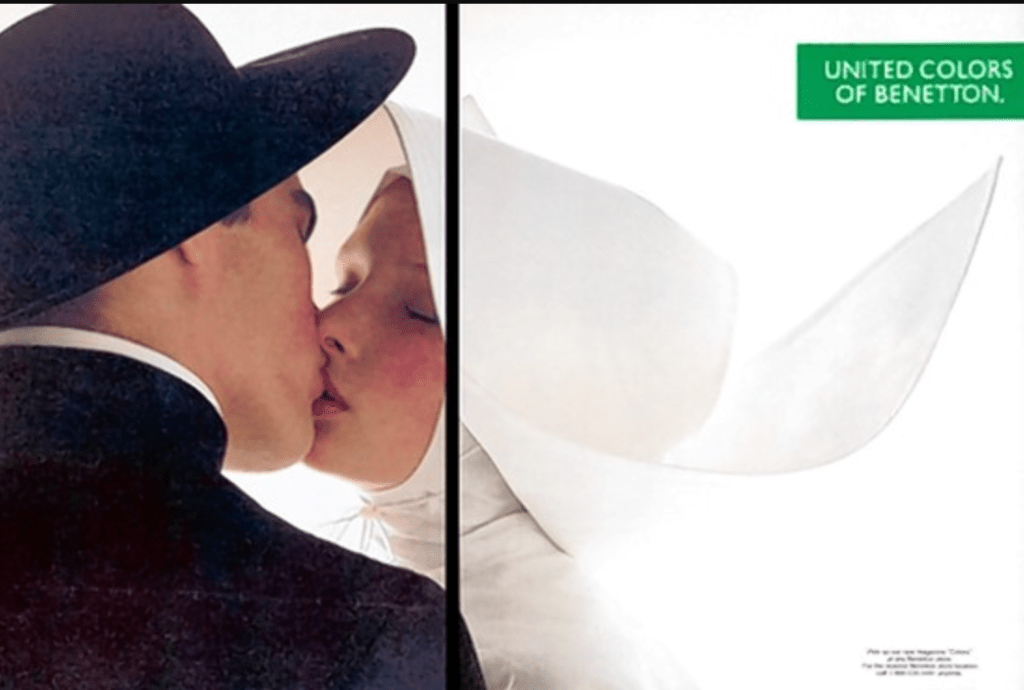
1991 issued two of Toscani’s most controversial works for United Colors of Benetton. In September, the fashion brand released two print ads to provoke conversations. The preface to the campaign stated that advertisements would “feature images from the real world which have some social and universal relevance, in order to break through the barrier of indifference which often surrounds these issues.” Sexuality and religion were at the forefront of “Priest and Nun.” Dressed in traditional liturgical vestments, the ad featured a priest clad in black romantically kissing a nun dressed in white. Concerned citizen groups, the Catholic Church, and politicians called for banning the image and demanded an apology from the fashion brand. The controversy continued with “Angel and Devil.” The image of two children presented a cherubic, smiling white girl with blond tresses embracing an androgynous Black child with hair shaped into horns looking frightened. Again, the ad caused outrage, with those on all sides of the spectrum calling for a boycott. By the early 1990s, Toscani transitioned from the smiling, hand-holding youth of various global and ethnic identities to addressing the racial and sexual stereotypes and barriers rampant in our society. Society wanted the feel-good emotions of aspiration without the struggle of addressing the obstacles to our freedom. Toscani, always the vanguard, knew our collective aspiration and liberation would require us to openly and honestly discuss the social and political constraints that perpetuated racial, gender, and sexual oppression.
While Toscani was pushing people to talk about societal constraints with depictions in black and white, most did not recognize the racial lines in America were drawn in Black and white. By the dawn of 1990, the Berlin Wall fell, and Eastern European countries opened borders and held free elections, ending decades of communist governments. In the latter part of 1991, the U.S. and Soviet Union signed the Strategic Arms Reduction Treaty, known as START, agreeing to reduce their nuclear weapons by one-third. The Union Of Soviet Socialist Republics dissolved, granting complete independence to 15 constituent countries. The continual threat of atomic annihilation disappeared with the Iron Curtain and the ending of the Cold War.
A changing global outlook coupled with the hope of a new president. Eleven years of Reagan-Bush politics had a toll on the U.S. economy, creating a recession with significant unemployment and slow job recovery. Bush’s vice president, Dan Quayle, floundered often in the international and domestic arenas. Quayle’s public appearances were notably awkward and demonstrated his deficient language skills. He talked about speaking Latin in Latin America, encouraged NASA to enter the space race, and erroneously corrected a sixth grader during a spelling bee. Quayle would go on to chastise the television character, Murphy Brown, in his speech, Reflections on Urban America, citing single mothers’ erosion of the family structure and creating a “poverty of values.” A recession, a dullard, and an attack on a fictional character made Bush and Quayle out of touch with a country barreling toward the turn of the century. When Bill Clinton announced his candidacy for president in October 1991, Americans were ready for something fresh and new.
While change was in the air, Black Americans experienced the same expressions of racial hatred that were sewn into the country’s foundation. Rodney King, a 25-year-old Black man living in Los Angeles, was pulled over after a high-speed chase. Once stopped, police ordered King out of the car. They tased him and forced him to lie on the ground with pistols drawn at him. Police officers then kicked and beat King with batons for over fifteen minutes, resulting in broken bones, skull fractures, and brain damage. George Holiday videotaped the incident from his apartment. The video of King’s beating is made worse by the dozen predominantly white officers standing by, offering commentary on the violence. Holiday offered the footage to the LAPD, who were uninterested before providing the tape to KTLA. The footage was broadcast worldwide, finding most white Americans in disbelief while Black Americans were reminded of their harsh reality.
By the late 1980s, I had found my place on the dance floor. As a college student at Wake Forest, I frequented the local clubs, The Edge in Greensboro and The Orchestra Pit in Winston Salem, on Thursdays and Fridays. Occasional semester trips to Atlanta had me on the dance floor at Boys & Girls (later renamed Velvet). While these clubs were critical, my ritual Saturday night was spent on the dance floor at Park Elevator. The Park Manufacturing Company on the corner of Arlington and South Boulevard became the club’s home in 1987, revisioning the industrial past into the underground disco scene. By 1990, Park Elevator moved to Cedar Street with an elongated dance floor, platforms centered with graffiti poles, an adjacent patio, and a raised DJ booth.
The cityscape with Charlotte’s skyscrapers and scaffolding disappeared as patrons walked down a few steps, carrying them through the club’s threshold. Continuing left past the entryway’s mechanical and steel facade revealed flashing lights, warm and raucous, highlighting the moving silhouettes. The chassé of the crowd was sensual, energetic, robust, expressive and optimistic. From every angle, the dance and dancer were prominent. The mirrored ball projected starlight onto Dominique in her low-cut wrap dress accentuated with a polka dot belt and hosiery. Micah’s mechanic pants were tucked into his knee-high army boots as his sleeveless oxford opened to reveal an oversized cross necklace. Porter’s finger curls were the perfect crown to her champagne satin hot pants, black and white striped nautical top, and multiple rosary beads clustered in greens, blues, and pinks. I was wrapped in a vintage Soviet military jacket and floral scarf with wide-leg velvet sailor pants that flowed on the dance floor. As the night went on, my jacket and scarf were abandoned in a corner, revealing my favorite United Colors of Benetton t-shirt that hosted a human figure with the slogan “Think About It” placed near the person’s head. Around the perimeter were words: AIDS, VIOLENCE, and PAIN. Gabriel and I were often on a platform where our pas de deux slipped in and out of solo movements. His lanky figure draped in a billowy white tunic over white harem pants and shoes offered a celestial presence above the revelry. Frankie Knuckles, the legendary DJ at the Warehouse in Chicago, always reminded people that the dance floor held our sanity because dancing focused on the love we wanted, not the cruelty of our reality. Together, we slipped, swayed, clapped, and stomped, hoping our movement would, as the sun rose, bring a new dawn.
Sound + Vision: Velvet ASpirations (The 1991 United Colors Of Benetton Edition)
1. The Pressure, Prt. 2, The Sounds of Blackness
2. Change (Frankie Knuckles Remix), Lisa Stansfield
3. Sadeness (Part I) (Extended Trance Mix), Enigma
4. Justify My Love (Hip Hop Mix), Madonna
5. The Choice Is Yours (Revisited), Black Sheep
6. I Need You So Bad Baby (Heavenly Mix), The Crucibles
7. Spanish Heart (Feat. Brrnard Sumner), 808 State
8. People Are Still Having Sex (Mo Sleezy Mix), LaTour
9. Mama Said Knock You Out (7 A.M. Mix), LL Cool J
10. Got A Love For You (Hurley’s House Mix), Jomanda
11. Finally (12-inch Version), CeCe Peniston
12. Such A Good Feeling (Inspiration Delight Mix), Brothers in Rhythm
13. Now That We Found Love (Club Mix), Heavy D & The Boyz
14. It Should Have Been Me (Touchdown Mix), Adeva
15. No More (Feat. Erica Harold), Unique 3
16. Strike It Up (Feat Stepz) (DJ Lelewel Mix), Black Box
17. Sweet Ambience (NY Jazz Mix), Lovechild
18. Good Beat (Extend The Beat Mix), Deee-Lite
19. Getting Away With It (Nude Mix), Electronic
20. Touch Me (All Night Long) (Club Mix), Cathy Dennis
21. It’s A Shame (My Sister) (Feat. True Image), Monie Love
22. Too Blind To See It (Hurley’s House Mix), Kym Sims
23. Always There(Feat. Jocelyn Brown) (Morales Mix), Incognito
24. Waterfalls (Daybreak Mix,) After Hours
25. Gypsy Woman (Basement Boy Mix), Crystal Waters
26. Go (Woodtick Mix), Moby
27. Get Off (Feat Eric Leeds) (Flutestramental), Prince & The New Power Generation
28. Little Fluffy Clouds (Coldcut Heavyweight Dub), The Orb
29. Let The Beat Hit ‘Em, Lisa Lisa & Cult Jam
30. Sunshine On A Rainy Day, Zoe
31. Hold You Tight, Tara Kemp
32. Kiss Them For Me, Siouxsie & The Banshees
33. Poor Georgie, MC Lyte
34. Never Stop (Heavies Extended Remix), The Brand New Heavies
35. Optimistic, The Sounds Of Blackness
36. I Wanna Sex You Up, Color Me Badd
37. Check The Rime, A Tribe Called Quest
38. Be Thankful For What You’ve Got, Massive Attack
39. Step Right On, Young Disciples
40. Diamond And Pearls, Prince & The New Power Generation
 The Last Boudoir in Angier
Leave a comment