“Is that a girl’s sweater?” “The question interrupted my pen, circling and triangulating lines on a blank page. If Prince could wear high heels, Adam Ant could wear make-up, David Lee Roth could wear fishnet gloves, Boy George could wear dresses, and Bowie could wear absolutely everything, then surely no one at Hendersonville High School would notice or care about a gray floral sweater. The question proved my logic was flawed. Shrugging it off, I responded with the only syllable I could muster, “What?” My interrogator was not satisfied. “Seriously, dude, is that a girl’s sweater?” Silently, no words would form, and I stared firmly into the eyes of my inquisitor. “Oh, shit! It is. Hey, he’s wearing a girl’s sweater.” The bellman loudly announced my gender transgression.
By 1984, gender seemed démodé at Benetton. The Italian brand began in 1965, bringing colorful knits to a landscape dominated by charcoal, brown, and navy. Benetton opened its first boutique in Northern Italy in 1966, expanded to continental Europe in the 1970s, and, by 1980, opened its first store in the United States. The company’s rapid growth placed Italian upscale knits in 3,000 Benetton shops worldwide, selling 39 million garments for a revenue of $350 million by the end of 1983. The group solidified its maverick status by becoming the world’s largest wool consumer and knitwear maker. By December of 1984, Benetton was a global force that crossed the Iron Curtain, the Bible Belt, the Rust Belt, and the continental divides.
Benetton distinguished itself from other retailers with a future-oriented aesthetic. Usually anchored near an upscale department store, the retailer featured an electric green and silver facade welcoming customers into a small, sparse space. The studio lighting, intentional and detailed, combined with an international soundtrack to simultaneously emulate an art gallery, small disco, and spaceship. Furniture was restricted to one sleek counter dedicated to financial transactions at the front of the store. The middle of the store was open, while the perimeters meticulously housed garments. Hanging clothes were kept to a minimum, while modular units resembling 1970s Italian design featured folded garments stacked from floor to ceiling. There were no mannequins, only large pictures of young people from around the world wearing colorful knits. Before you entered the store, you were in Greenville, South Carolina, during the summer of 1983. Across the threshold, you entered an Italian spacecraft stylishly floating into the future.
When Benetton’s four annual collections debuted in the store, they were not separated by gender but arranged by color families. Along the wall, colorful columns of magenta, crimson, and tangerine blended into towers of lemon, aqua, and teal. Most Americans were unfamiliar with a European sizing system and not accustomed to pristinely folded knits not on full display. Both elements combined to underscore Benetton’s elegance and modernity. Above the colorful pillars, images of global youth wearing deep hues found in Benetton cardigans, crewnecks, and t-shirts provided a pronounced visual landscape. A girl from the Soviet Union could be wearing the same sweater as a boy from the United States, and an androgynous person from Europe could be wearing the same cardigan as an androgynous figure from Africa. Teens from South America, girls from Japan, boys from China, and children from India all wore similar knits. Benetton’s message was clear. Geography and gender need not be separating factors. At Benetton, the garments were for everyone.
I was part of the everyone. The gray sweater outlined faded chrysanthemums, dahlias, and roses in cream, yellow, and teal. The slightest branch of lilac danced sparingly across the sleeves and near the collar. The floral arrangement cascaded from the left shoulder to a centerpiece, soft and luscious. Rather than adopting the primary colors and geometric graphics of the early 1980s, the flowers looked hand-painted and muted, and when I tried the sweater on, it felt like I was wearing an artist’s canvas. Other factors persuaded me to purchase the cardigan rather than gender. My best friend said I looked “fresh,” and I loved flowers.
By 1984, flowers were interposed into the digital landscape. Andy Warhol photographed, sketched, and silkscreened hibiscus, poinsettias, and orchids while proclaiming, “I always notice flowers.” Jean-Michel Basquiat combined a keen sense of art history while embracing contemporary graffiti to create modern still lifes. The floral focus was also present with Robert Mapplethorpe, Joel Meyerowitz, and Yayoi Kusama. Off-Broadway produced Little Shop of Horrors, a musical comedy set in a flower shop featuring a blood-thirsty plant. Umberto Eco’s debut novel, Il Nome Della Rosa, combined literary theory and biblical analysis with a murder mystery set in a 14th-century monastery. The Italian novelist’s book was quickly translated into English as The Name of the Rose, selling millions of copies. Flowers had a subdued prominence from the gallery walls to the bookshelf and Broadway stage during the early 1980s.
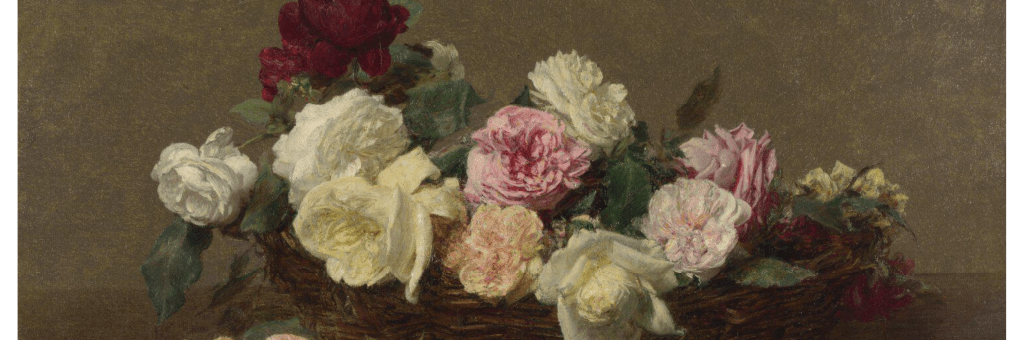
While the adults of the early 1980s noticed flowers in the avenues of the cultural elite, the teens of the 1980s saw flowers planted throughout the landscape of pop music. Teens have always been a critical demographic, and this was no different in the 1980s. The purchasing power of young consumers boosted significant post-recession growth in the record industry, spending $3.77 billion in 1983 and over $4 billion in 1984. Albums and cassettes supplemented their aural soundscape with visual images where minimalism and maximalism fueled graphic exploration. With millions of album covers passing through the hands of the American teens, flowers were everywhere. Steven Meisel shot a sepia-toned Madonna holding flowers for 1984’s Like a Virgin. Framed in stained glass panels, David Bowie’s messianic figure is surrounded by flowers on the cover of 1984’s Tonight. Purple Rain featured a floral frame around Prince mounted on a purple motorcycle gazing seductively through billows of fog. 1983 provided a romantic reproduction of French artist Henri Fantin-Latour’s A Basket of Roses on New Order’s Power, Corruption & Lies.
MTV was the visual companion to the young person’s soundtrack, supplementing the music with short three-minute videos that integrated sound and image. Launched in 1981, MTV was initially in 2.5 million American homes. By 1983, the music channel was in 17 million homes and would increase its reach to 25.4 million homes in 1984. The advent of the music video in heavy rotation 24 hours a day also brought a new social consciousness to its younger viewers. The fashion of the 1980s was placed in the spotlight as artists left the confinement of the magazine or the distance of the concert stage and danced across the home television screen.
While the first music video emulated the concert stage, subsequent offerings would borrow from films, offering plot, character, and special effects. The MTV generation could now view a unique hybrid of sound and vision.
Hybridity was not only present in form but also in presentation. When the musical artist became the video artist, dress codes tantalized its young viewers by adopting and incorporating articles of clothing from the opposite sex into their wardrobe. Cross-dressing has been a part of film since its inception. Marlene Dietrich wore a tuxedo in Morocco, looking dapper and seducing an audience. Men from Milton Berle to Dustin Hoffman put on dresses for comedic effect. Tim Curry’s groundbreaking performance in 1975’s The Rocky Horror Picture Show featured the actor in women’s lingerie, gowns, and capes, portraying a seductive and singing alien that is ultimately killed. Characters in films could dress like the opposite sex, but transgressing gender roles had a strict adherence: Women dressing as men were seductive. Men dressing as women were buffoons adding comedic results or villains needing annihilation. The new stars of music videos were not cross-dressing or buttressing gender tropes; they were dressing in a way that blurred the lines to such an extent that the term “gender bender” entered the vernacular.
Borrowing from the exaggerated make-up and clothing of 1970s glam rockers like Gary Glitter, The New York Dolls, and David Bowie, the artists of the 1980s understood style and glamor garnered attention. Elegance and attraction were the mainstays of the music videos where gender-bending combined perfectly for the youth revolution. In “White Wedding,” Billy Idol removed a motorcycle helmet, revealing perfectly applied eyeliner, blush, and lipstick while wearing a noticeable earring. Every synthesizer pop pretty boy from Duran Duran to Frankie Goes to Hollywood to Wham! wielded flawlessly applied mascara, lace, and leather while flaunting their sexuality. Annie Lennox shot to stardom as the lead singer of the Eurythmics, wearing men’s tailored clothes with an electric red buzz cut. In a video that questioned more than the identity of her lover’s new companion, Lennox is featured spying on a woman played by the infamous crossdresser Marilyn, the alias of Peter Robinson, while very cheekily asking, “Who’s that girl?” Boy George was never out of make-up, sporting looks that featured wedding gowns, kimonos, and overdresses. By 1984, Prince musically proclaimed he was neither a woman nor a man while adorning himself in thigh-high stockings, stacked four-inch high heels, and ruffled blouses. From the gaudy portrayal of hairbands and mascara metal to the queer-centric lead singers of the New Romantics, music videos questioned a gender-specific mode of dress, underscoring that not only was their music a production, but gender itself was a performance.
Gender-bending in the 1980s could give the impression that equity and the inclusion of myriad expressions of genders and sexualities were the norms. They were not. While men could adopt forms of dress attributed to women, being a woman was more difficult. In every sector of the United States, women were underpaid and underrepresented. Since the 1960s, women entered higher education in large numbers, disrupting the expected gender roles of their mothers. Yet, campus enrollment had 1.6 males for every female. Although the gap almost evaporated by the 1980s, men still had significantly higher graduation rates and job placement. When women entered the workplace, they earned 61% of their male counterparts’ salaries in the same position. Fewer economic resources contributed to health inequities, political underrepresentation, and social discrimination. Women were more likely to be the targets of sexual harassment and sexual assault while being denied proper avenues to receive adequate care or report the crimes. Women were trying to change the social mobility of their lives in a daunting landscape. A 1984 poll found that 48% of men favored traditional gender roles, and this percentage rose as the 1980s progressed. These inequities were amplified when race was also a factor, making women of color more vulnerable than their white counterparts. Men wearing high heels on stage were glamorous. Women wearing heels on the street or in the boardroom was perilous.
The male images of MTV may have presented a free sexuality where Frankie’s visit to Hollywood included male-on-male relaxation, but reality featured a very traditional and buttoned-up version of heterosexuality. The American Psychiatric Association voted in the 1970s to downgrade homosexuality from a psychiatric disorder to a sexual orientation disturbance. You may not have been crazy, but you were still wrong. Jerry Falwell, the spokesperson for the Moral Majority, used his platform throughout the 1980s to attack queer people, defining them as amoral, sinful, and the recipients of God’s much-deserved wrath, AIDS. The Supreme Court ruled that the Fourteenth Amendment did not prevent a state from criminalizing private sexual conduct involving same-sex couples in Bowers v. Hardwick. While men and women were coming out of the closet in record numbers, increasing the visibility of LGBTQIA+ people in the workplace and society, the major political, religious, and medical systems of the country continued to refuse them full rights and acknowledge their humanity.
Gender-bending was profitable for image, but homosexuality was still taboo. Prince could wear lace and heels in Purple Rain as long as Apollonia was the object of his desire. George Michael may have been a young gun, but when the video for “Everything She Wants” was finished, he was shown in bed with a faceless female’s hand caressing his locks. Boy George may have been the most flamboyant of the gender benders, but his sexuality was swept under the rug. In 1983, during his first appearance on The Tonight Show, Joan Rivers, filling in for Johnny Carson, conducted an interview that fetishizes the appearance of the Culture Club lead singer. When sexuality was addressed, Boy George used wit to diffuse the situation. The pop star admitted to being bisexual as the audience audibly gasped. He then commented that he was too busy for love. Music is not discussed in the ten-minute interview until almost the seven-minute mark. By minute eight, Joan Rivers refocused the conversation on the singer’s hair and make-up. Jerry Seinfeld was also a guest that night, and the host asked him no questions about his dress or sexuality. When Boy George returned to The Tonight Show in 1984, Johnny reminded him that his Midwestern Nebraska values made his acceptance of the singer difficult. Dressing outrageously could sell records. Being out of the ordinary was offensive to our American heteronormative sensibilities.
In 2023, many state legislators forwarded bills targeting the LGBTQIA+ community, focusing on transgender people. Many of the laws prevent transgender youth from receiving adequate healthcare, participating in school sports, studying points of queer history, and obtaining equal protection under the law. While the flurry of bills passed through state governments, people opposed to the actions began posting a particular meme on social media platforms. In all capital letters, the meme read, “I DON’T REALLY UNDERSTAND HOW PEOPLE WHO WERE YOUNG IN THE 80s ACT SO CONFUSED ABOUT GENDER IDENTITIES WHEN THE CELEBRITIES OF THEIR TIME LOOKED LIKE THIS.” Below the wording was an image featuring Grace Jones, Boy George, Annie Lennox, and Prince. Although I want to think the originator of the meme had good intentions, I recognize their misunderstanding of the 1980s queer life. Gender-bending celebrities cannot be correlated with acceptance, celebration, and equal rights. Many LGBTQIA+ teens and adults were kicked out of their homes and disowned from their families. Queer people were bullied, physically attacked, and suffered other humiliations. Gay men with AIDS were ignored by the government and left to die in astronomical numbers. I also do not think the meme’s composer understands that the vilification of queer lives we saw in the 1980s is the same attacks we are seeing currently. 30% of queer youth will experience homelessness before age 19. 1 out of 5 transgender youth will attempt suicide because they are continually the targets of bullying, physical violence, and discrimination. LGBTQIA+ people are still nine times more likely than their straight counterparts to experience violence in their lifetime.
The herald, shocked at my floral cardigan from Benetton, graduated to become my bully. By the time I finished high school, he regularly threatened me, prank-called my house nightly, wrote “Faggot” all over my locker, and physically assaulted me. When my parents intervened and demanded a school meeting, administrators suggested my problems would disappear if I transferred to another school. I did not. And I did not stop wearing the floral cardigan from Benetton.
Through the 1980s, Benetton’s trademark label was designed by Franco Giacometti and featured a symbol known as polipetto. A traditional polipetto descends from artisanal textile artists who decorated their weavings with an octopus and its outreaching tentacles. Giacometti’s rendition resembled a stick figure, grounded with a curved arch for feet and outreaching with open triangle hands. The glyph recalls the gender pictographs used in biology and medicine to represent sex and gender. Carl Linnaeus regularly used the planetary symbols of Mars, Venus, and Mercury as signs for genders. Giacometti’s glyph most resembles Mercury (☿), Linnaeus’s designation for a third sex, signaling that in the futuristic world of Benetton, every human represents every gender and sexuality. In 2010, The Linnean Society reframed their symbology, assigning Mercury to the botanical world as the glyph for flowers.
I have never stopped gender-bending. My wardrobe revolves around color, texture, print, silhouette, and fit, more critical elements than gender in the sartorial world. Recently, I was meeting a friend for coffee. While standing in line, the young man in front of me began eyeing my ensemble. He gazed at the olive, military-style overshirt covering my cardigan’s brown and black floral outlines. His eyes scanned upwards, focusing on the Italian silk scarf blooming with gold dahlias. The stare lingered to become longer and noticeable, edging into discomfort. His mouth moved, and his words escaped and hung in the air. “Your scarf . . . ” I now stood completely still, facing my inquisitor with rigidity while my eyebrows raised, signaling him to continue the examination. “Your scarf is beautiful.”
Sound + Vision: Flowers (The 1983-1984 Benetton Edition)
- Smalltown Boy (12-inch Version), Bronksi Beat
- Send Me An Angel, Real Life
- Ecstasy, New Order
- Sweet Dreams (Are Made Of This) (Steve Angello Remix), Eurhythmics
- Relax (New York Mix), Frankie Goes To Hollywood
- People Are People (Different Mix), Depeche Mode
- I.O.U., Freeze
- I Didn’t Mean To Turn You On, Cherelle
- Get It Right, Aretha Franklin
- Candy Man (12-inch Mix), Mary Jane Girls
- Young Guns (Go For It) (12-inch Mix), Wham!
- New Moon On Monday (Dance Mix), Duran Duran
- Strip, Adam Ant
- Blue Jean, David Bowie
- Major Tom, Peter Schilling
- Live On Video, Trans-X
- Somebody’s Watching Me, Rockwell
- Operator (12-inch Mix), Midnight Star
- (Keep Feeling) Fascination (Improvisation), Human League
- Erotic City (Make Love Not War), Prince & The Revolution
- Automatic, The Pointer Sisters
- Rockit, Herbie Hancock
- Unlimited Capacity For Love, Grace Jones
- Jam On It (Definitive Version), Newcleus
- Wot, Captain Sensible
- Self Control, Raf
- Flesh For Fantasy, Billy Idol
- Human Nature, Michael Jackson
- Time After Time, Cyndi Lauper
- Nothing Looks The Same In The Light, Wham!
- Black Money, Culture Club


Leave a Reply