
Ancient Egypt is recognized in various circles for its innovations in architecture, noting the Pyramids and sphinx of Giza. Scholars also point to the advancements in writing that helped the society codify its language and record keeping. Equally important, obelisks assisted in measuring the passing of time, and the Egyptians were inventive in the medical field, creating tools and protocols to address myriad physical ailments and bodily injuries. Ancient Egyptians were also concerned with the adornment and enhancement of the body. Advancements in cosmetics allowed women and men to augment their physical appearance with kohl, animal pigments, and natural sugars. Beauty products aided skin treatments while offering a protective function against a bright sun and attracting positive attributes from the spiritual realm. Egyptian clothing was woven from byssus (flax), cotton, or linen, fashioning simple tunics and kilts that were belted with fabric, rope, or leather. Jewelry and fabric treatments elevated the natural fabrics, and by the late Middle Kingdom (2040 BCE – 1782 BCE) and New Kingdom (1570 BCE – 1069 BCE), beaded tunics, elaborate jewelry, and wigs appeared in great frequency. Although all of these designs have modern implications, there is one sartorial creation that is found in almost everyone’s modern wardrobe: The pleat.
Over four thousand years ago, the Egyptians developed the technique of folding fabric on top of itself to create the pleat. Although the schenti and kalas, the two primary pieces of clothing in Egyptian culture, were worn by everyone, the garments started featuring pleats among the nobility class. The lack of a starching agent and the effect of water to smooth linen required pleating to be performed each time the garment was cleaned. Initially, the pleats were folded by hand or on a board with every wear, a laborious and time-intensive task. For centuries, scholars assumed the elaborate pleating in the garments of ancient Egypt was recreated with each wear. The 1906 excavation of the tomb of King Nebhepetre, now known as Mentuhotep II (Dynasty XI) in Deir el-Bahri altered this assumption. Seven garments dating to ca. 2100 BCE had perfectly retained pleats. After scientific analysis, gelatinized starch and plant gum were found in the threads, supporting the hypothesis that the Egyptians treated clothing with a substance to reinforce the pleats and lightly stiffen the textiles. Ann Richards, the textiles expert, has theorized that the stiffening agents were applied in the weaving process, causing the garments to pleat when interacting with water. Technique and innovation made the pleat a desirable sartorial choice for wealthy and noble Egyptians.
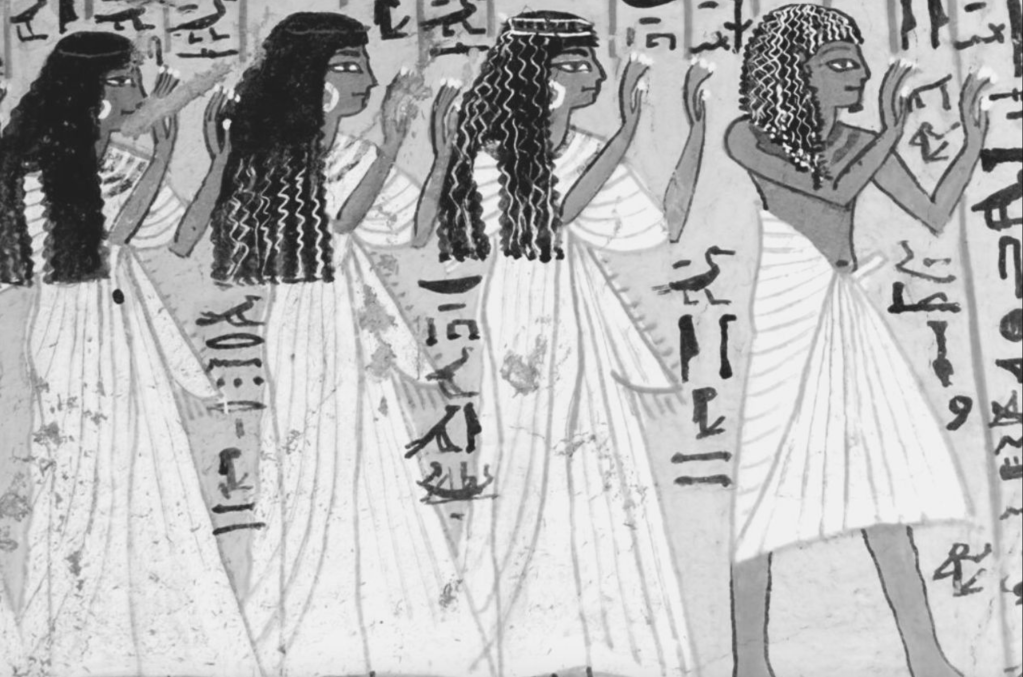
Beyond the Egyptians, pleats continued to be a signifier of culture and luxury. Pleated collars were adorned by nobility in the 16th century. Known as ruffs, the collars were delicate and desirable, often stored in special boxes before losing their shape after one wear. The Greek Fustanella, like the chiton or podea, was a military tunic. The fustanella features over 400 pleats that represent the liberation of Greece from the Ottoman Empire. Like the Scottish kilt, another pleated military skirt, the pleats extend beyond the practical technique of providing room or the fashionable innovation, providing style and representing power and virility.
Mariano Fortuny revolutionized the pleated dress at the beginning of the twentieth century. The Venetian designer borrowed from the ideas and silhouettes of the chiton to create a dress known as Delphos. The Delphos was constructed from silk and taffeta, combining four to five swaths of finely pleated cloth. The pleats were both practical and delicate. The Delphos could be folded or rolled and still maintain its shape and pleats. However, it could not be washed because the pleating would disappear. The dress’s neckline and sleeves were adjustable, featuring silk drawstrings decorated with Murano glass, and the patent for the dress acknowledged Fortuny’s wife, Henriette Negrin, as the dress’s designer. The Delphos was revolutionary and was heralded by many. Joaquín Sorolla painted portraits of his wife wearing the dress, Marcel Proust described the gown in his novels, and The Museum of Modern Art featured it in their permanent collection.

Modernity has a fickle relationship with pleats. During the Jazz Age, pleats were featured in dresses, skirts, and trousers for men and women. Economic prosperity often dictates the parameters of style, and with financial prosperity comes mobility and activity, making the fashionable pleat a necessity. When the 1980s ensued, the pleat regained prominence and was a sartorial marker of the decade’s excess and indulgences. Pleats were ubiquitous, visible on trousers, skirts, dresses, jackets, shoulders, and denim. Claude Montana, Thierry Mugler, and Christian Lacroix folded colorful fabrics in various ways, featuring the pleats on the runway and in magazines. Tailoring emphasized pleats with Ralph Lauren and Giorgio Armani constructing lifestyle brands. By the mid-1980s, The Gap brought the pleated khaki to malls in every major city.
The 1990s left the color and indulgences of the 1980s, embracing austerity as the sign of the times. As Generation X matured into adulthood, they rejected the ethos of the 1980s. While their parents were experiencing an economic upswing, they were latchkey children left to fend for themselves. These young people viewed capitalism and its byproducts with a negative lens. Social classes were restrictive, productivity was consuming, and profit came at too high a price. The cultural capital shifted, leaving the multi-cultural epicenter of New York and centering around the Pacific Northwest’s Grunge scene. Grunge’s attitude ushered in an austerity that paralleled the restrictions Generation X felt in society. The pleat was abandoned, and flat fronts and slim silhouettes emerged. Anna Sui and Marc Jacobs were the first to feature the restrained style on the runway. While designers shifted en masse to subdued colors and unadorned fabrics, one designer was embracing the pleat as both a form of modernity and art: Issey Miyake.

Issey Miyake was born as Miyake Kazumaru on April 22, 1938, in Hiroshima, Japan. The designer rarely discussed his childhood, experiencing the trauma of the U.S. atomic bombing of Hiroshima that took the lives of hundreds of thousands of Japanese civilians on August 6, 1945. Miyake’s family was among the casualties. The bombings of Hiroshima and Nagasaki fulfilled the U.S.’s desire for a quick ending to World War II, and the culmination came with significant cost. Japan suffered excruciating loss of human resources, a decimated landscape, and a scarcity of basic necessities needed to sustain life. The privity of the 1940s and 1950s in Japan was the backdrop for Miyake’s invention, and the designer would center hope as the key element of his designs.
Isamu Noguchi completed Hiroshima’s Memorial Peace Bridge in 1952, naming the railings for the east bridge Ikiru (To Live) and the west bridge Shinu (To Die). During construction, the rails were renamed Tsukuru (To Build) and Yuku (To Depart) partway through construction in order to disassociate them from Akira Kurosawa’s 1952 film, Ikiru. Issey Miyake was inspired by the dual function of the design, which functioned as a connector between parts of the city while inspiring travelers to contemplate the future.

Form, function, meaning, and beauty governed Miyake’s first designs, and before graduating from Tama Art University’s Department of Graphic Design in 1964, the young designer presented Nuno To Ishi No Uta, Poems of Cloth and Stone, to the Tokyo Chamber of Commerce in 1963. Miyake entered the design competition at the prestigious Bunka Fashion College. When the committee noted the young designer lacked specific pattern-making and construction skills, Miyake moved to Paris and enrolled in Chambre Syndicale de la Couture Parisienne. By 1966, Miyake’s career in fashion gained traction when he acquired a position with Guy Laroche. As a design assistant, Miyake was efficient and productive and soon moved on to the House of Givenchy. Miyake’s foray into couture was augmented by his fascination with Brancusi and Giacometti, sculptures he viewed regularly in Paris museums. While French couture and art offered an essential foundation for construction and beauty, the 1968 Paris Student Riots solidified Miyake’s democratic ideals that believed sublime and practical clothing should be for the universal public.
If democratic ideals were necessary, then Miyake knew the United States was fertile ground for exploration, and in 1969, he moved to New York City. Columbia University hosted English classes that enhanced the young designer’s language skills, and a job with Geoffrey Beene exposed Miyake to an explosion in quotidian fabrics for elevated prêt-à-porter. As with his whole life, Miyake ignored the lines of demarcation that separated art, design, and fashion. His enclave to New York’s fashion world was supplemented by his traversing the New York art world, where he befriended artists, including Christo and Robert Rauschenberg.

In 1970, Miyake returned to Tokyo and established the Issey Miyake Design Studio. Democratic ideals spilled over into the function of the studio, where designers worked as collaborators in the creative process. The studio also embraced mechanical innovation, and when Miyake was invited to participate in the Toray Knit Exhibition, he showcased articles of clothing that could be disassembled and reassembled to accommodate different social functions. By 1971, Issey Miyake was showing in New York, and by 1973, he started presenting his collections in Paris. The Miyake Collections quickly garnered attention, with buyers and editors confirming their seats at the presentation. The democratization of the studio was infused into the clothing itself with pieces featuring the connection between the cloth, the body, and the liminal space created between their interactions. Miyake underscored this interdependence by cutting from a single piece of cloth.
Cutting from a single piece of fabric was not an innovation. Traditional Japanese kimono makers have been constructing garments using a single cutting for centuries. Although the concept was traditional, the shapes created were utterly innovative, redefining and infusing ready-to-wear with a sculptural and sublime aesthetic. Miyake synchronized Japanese tradition with the techniques of Parisienne couture and the attitude of New York fashion in a style most critics dubbed as “East Meets West.” Western ideas also expressed themselves in prints when Makiko Managawa, a textile expert with the Issey Miyake Design Studio, created a Japanese-style tattoo of Jimi Hendrix and Janice Joplin featured on a jersey dress. Known as “Tattoo,” the dress is considered a significant piece in the studio’s oeuvre and is featured in the permanent collection of the Kyoto Costume Institute. Miyake’s experimentation continued into the 1970s and 1980s, expanding from the garment to studying the individual threads and their reactions to different chemical treatments and processes.

Miyake began researching age-old techniques, visiting places where traditional methods of weaving and dying were in danger of becoming extinct. The body and movement of the body remained central to the designer’s principles, and Miyake began experimenting with nontraditional materials such as paper and plastic using traditional processes. From this point, the 1980s became a series of accomplishments. Miyake added additional lines to Issey Miyake Studio. A strong collaboration lasting almost a decade was formed with the photographer Irving Penn, resulting in over 250 photographs. By the end of the decade, the Musée des Arts Décoratifs in Paris presented an exhibition focusing on Miyake’s designs and process called Issey Miyake: A-ŪN.
William Forsyth and the Frankfort Ballet made a request of the designer that would significantly change the trajectory of Miyake’s studio and fashion. The choreographer needed costumes that would support freedom and movement for his new ballet, The Loss of Small Detail. Miyake began experimenting with pleats. With hundreds of pleated costumes, the dancers were thrilled, and Miyake was inspired by the interaction of the new pieces and the wide range of movement in dance. Miyake and his studio began experimenting with various techniques with the sole goal of bringing pleated clothes to ordinary citizens, making the designs as universal as t-shirts and jeans.
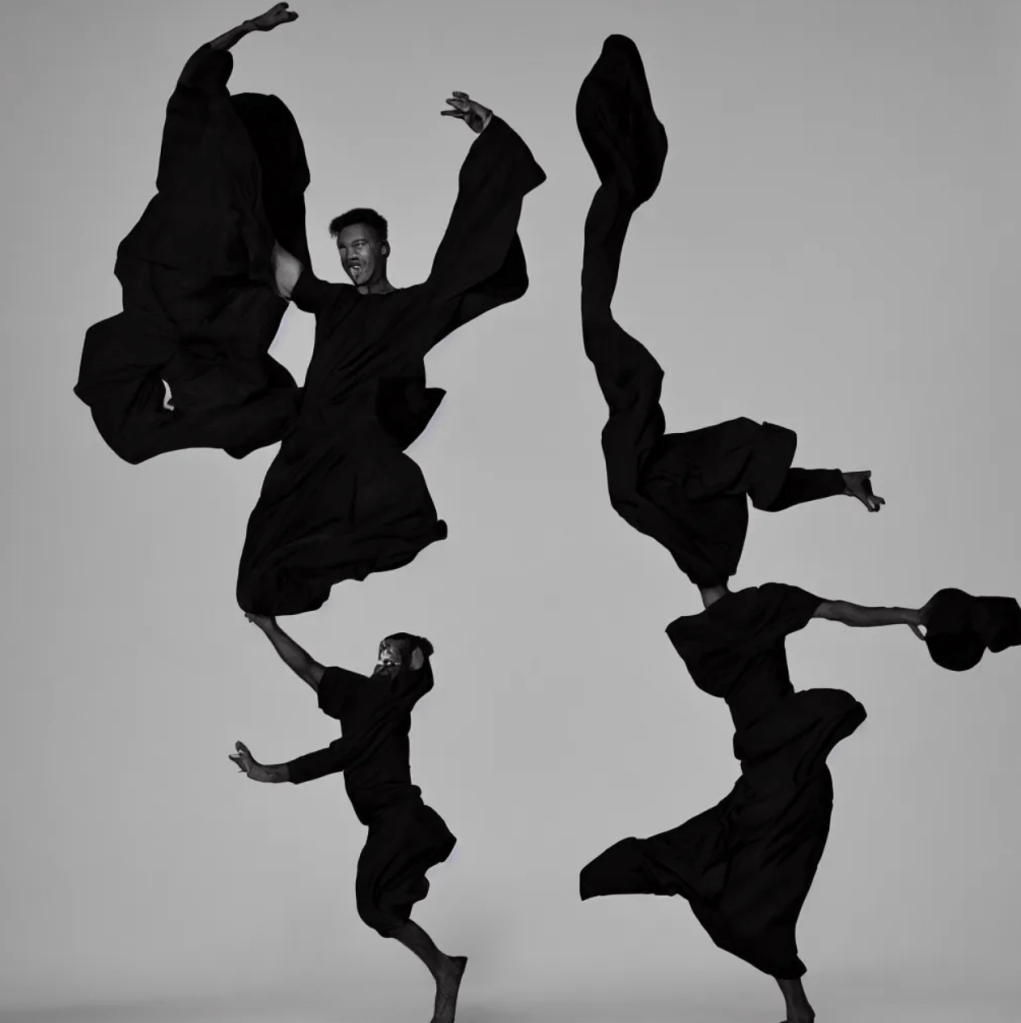
Miyake’s approach to pleating was different from the methods he garnered from the couture houses of Paris. Instead of working with pleated material, the designer reversed the process. Miyake relied on a high-end polyester with intense fabric memory to cut and sew oversized garments. Next, he placed the garments between pieces of paper and used a heat press to simultaneously shrink the garment to the preferred size and permanently create pleats. The technique became known as garment pleating, which led to the creation of specific machines and the realization of Miyake’s desire for democratic clothing. The designer noted the importance of this innovation:
It is our job as designers to create clothes from materials in such a way that those who wear them have the freedom of expression and its resulting joy.
The garments featured bottoms, tops, and outerwear that were wrinkle-free, could travel easily, and never lost their distinctive shape and texture. With Miyake’s advancements in fabric technology, innovation in garment cutting and construction, and restructuring of the pleating process, the designer fulfilled his desire for sublime and democratic clothing suitable for every day and every occasion. The response was overwhelmingly positive, and Miyake launched Pleats Please By Issey Miyake in 1993.

1993 held another democratic and hopeful moment on January 20, 1993, with the inauguration of the United State’s 42nd President, William J. Clinton. After twelve years of the older Ronald Regan and George Bush, Clinton promised a change with his youthful presence, the courting of late-night talk show circuits, and sartorial choices that included sunglasses and a saxophone. Clinton promised a more modern and free country, and in front of an inaugural crowd of thousands, he stated, “A new season of America Renewal has begun.” American restoration was needed after the previous administration had left the country with a 20-month recession, a quagmire in Iraq with the Gulf War, and an anachronistic response to a changing and modern social landscape.
The ceremony signified a pronounced shift as one of the youngest elected presidents at age 46 replaced one of the oldest presidents at age 68. On the platform were young children and teens, daughters and sons of the new president and vice president. Pop stars, actors, activists, and everyday Americans cheered on the hour-long ceremony. Days before, Clinton promised to bar any discrimination against the LGBTQIA+ community in the military, congressional offices, and the Department of Defense. Talk of a government-sponsored healthcare system abounded, and the newly-elected president called on citizens to serve in their community. There was a distinct shift from the excess and greed of the Reagan-Bush administration of the 1980s and early 1990s to a promising horizon. This clear reposition was most pronounced when Dr. Maya Angelou, the first poet to read at a presidential inauguration since Robert Frost, took to the podium and read “On The Pulse Of Morning.”
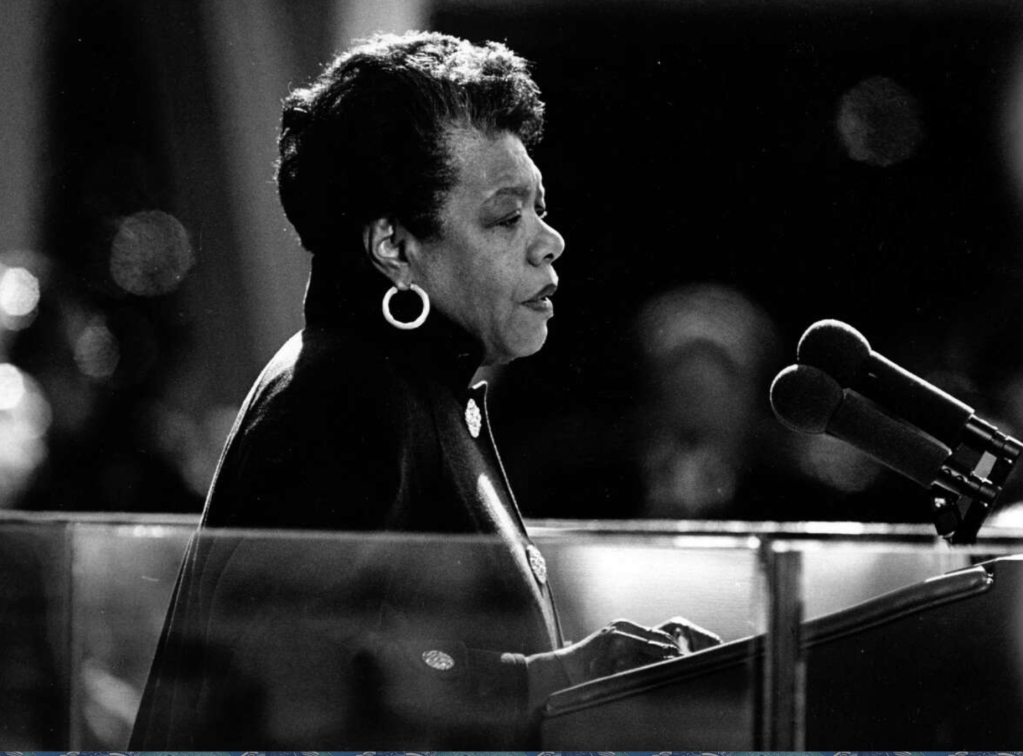
Dr. Angelou’s poem, filled with classical poetic mechanics, represented the country’s foundational democratic ideals with its free verse, detailing the human ingenuity and resources needed to make a fruitful and beautiful world. The poet’s voice, both commanding and inviting, passionately navigated her use of incidental rhyming and alliteration to emphasize the traits needed to overcome a brutal world. The poem’s title places it in a literary canon that often writes about morning as a metaphor for hope. Dr. Angelou draws attention to this idea and explicitly expands it in the last stanza of the poem:
Here, on the pulse of this new day; You may have the grace to look up and out; And into your sister’s eyes, and into your brother’s face, your country; And say simply, Very simply, With hope—Good morning.
If the new day, like in the creation myth she references, is going to be pronounced “good,” then it will require the efforts and talents of everyone on earth. With the poem, Dr. Angelou notes that hope and the future are not intellectualized nouns but communal verbs.

Miyake also underscored the importance of creating a new future, often saying his work was about creating a better society where life was more beautiful and moments of happiness were sublime. The poet and designer knew that creation and wonder were placed in the frailty of human hands. During an interview in the 1990s, Miyake commented about the Japanese word for clothing, hifuku. He then expanded, “hifuku means happiness. And probably I am trying to make hifuku, happiness, for the people. And for myself.”
By 1993, I was in graduate school and had experienced the tutelage of Dr. Maya Angelou at Wake Forest University and the sublimity of Issey Miyake, thanks to a white tunic from my mother’s closet. The white shirt hung effortlessly around my torso, soft while retaining the pleats and wrinkles that provided its distinctive look. While in school, I read a great deal about beauty, the contexts within which items were deemed beautiful, and the significance of beauty in culture. The theories and ideas were influential in my life and would shape various aspects of my career as a thinker and writer. Despite the philosophical implications, I knew that the most beautiful moments took effort and started when I walked down the hall and said, “Good morning.”
SOUND + VISION: Hope (The 1993 Issey Miyake Edition)

This week’s playlist reconstructs the promise and possibility found in 1993, the January 20th Presidential Inauguration, the poetry of Dr. Maya Angelou, and the work of Issey Miyake
- Incognito, Better (Instrumental Version)
- S.O.U.L.S.Y.S.T.E.M., It’s Gonna Be A Lovely Day (Easy Listening Sax Instrumental)
- M People, Don’t’ Look Any Further (M-People Master Edit)
- Janet Jackson, That’s The Way Love Goes, (CJ R&B Mix)
- Zhane, Hey Mr. D.J. (Remix)
- Salt-N-Peppa Featuring En Vogue, Whatta Man(Golden Girls Mix)
- Madonna, Fever (Shep’s Remedy Dub)
- Hardrive, Deep Inside (Shadow Child Remix)
- The Playground, Desire (N.Y. Vocal Mix)
- Robin S., Show Me Love (Extended Mix)
- Integration, Sax
- Oval Emotion, Don’t Make Me Wait (Raw Red Light Dub)
- Effervescence, Keep It Open (Juicy Mix)
- Grant Nelson, TT K.M.A. (Untitled Mix 2) (Sadly, Not On Spotify)
- MK Featuring Alana, Love Changes (MK Mind Mix)
- New Order, Regret (Fire Island Mix)
- Total Eclipse & Ronnie Canada, Come Together (T.M.V.S. Club Mix)
- Bizarre Inc., I’m Gonna Get Your (Original Flavor Mix)
- The Rhythm Masters, It’s In My Mind (Bayridge Mix)
- 2 Hype DJs, It’s Just A Groove (B.O.P. Till You Drop)
- Butch Quick, Higher (Club Mix)
- K.C.Y.C., I’m Not Dreaming (Media Mix)
- Smooth Touch, House Of Love (Love Mix)
- Blas D’Moure, Lover (Original Mix)
- Björk, Big Time Sensuality (Morales Def Radio Mix)
- Annie Lennox, Little Bird (Tee’s Freeze Dub)
- Mystic Phases, Don’t You Feel It (4 A.M. Mix)
- La India and Masters At Work, I Can’t Get No Sleep
- Rupaul. A Shade Shady (Now Prance)
- Bradford James, Seed In The City (Sadly, Not On Spotify)
- James Taylor Quartet, Love The Life
- Stereo MC’s, Step It Up
- Malaika, Gotta Know (Your Name)
- TLC, What About Your Friends
- Nu Colours, Come Go With Me
- Ultramarine, Kingdom
- Jamiroquai, Blow Your Mind
- Naughty By Nature, Hip Hop Hooray
- SWV, Right Here (Human Nature Radio Mix)
- Mary J. Blige, Real Love (Hip Hop Mix)
- N2Deep, Back To The Hotel
- MC Lyte, Ruffneck
- Dr. Dre & Snoop Dog, Nuthin’ But A G Thang
- 2Pac Featuring Digital Underground, I Get Around
- East 17, Deep
- Snoop Dogg, Gin and Juice
- Duran Duran, Come Undone
- Souls Of Mischief, 93 ‘Til Infinity
- Digable Planets, Rebirth of Slick (Cool Like Dat)
- P.M. Dawn Featuring Boy George, More Than Likely
- Sade, Cherish The Day
- Prince, Pink Cashmere
Listen on Spotify, YouTube, or Apple Music
 The Last Boudoir in Angier
Leave a comment