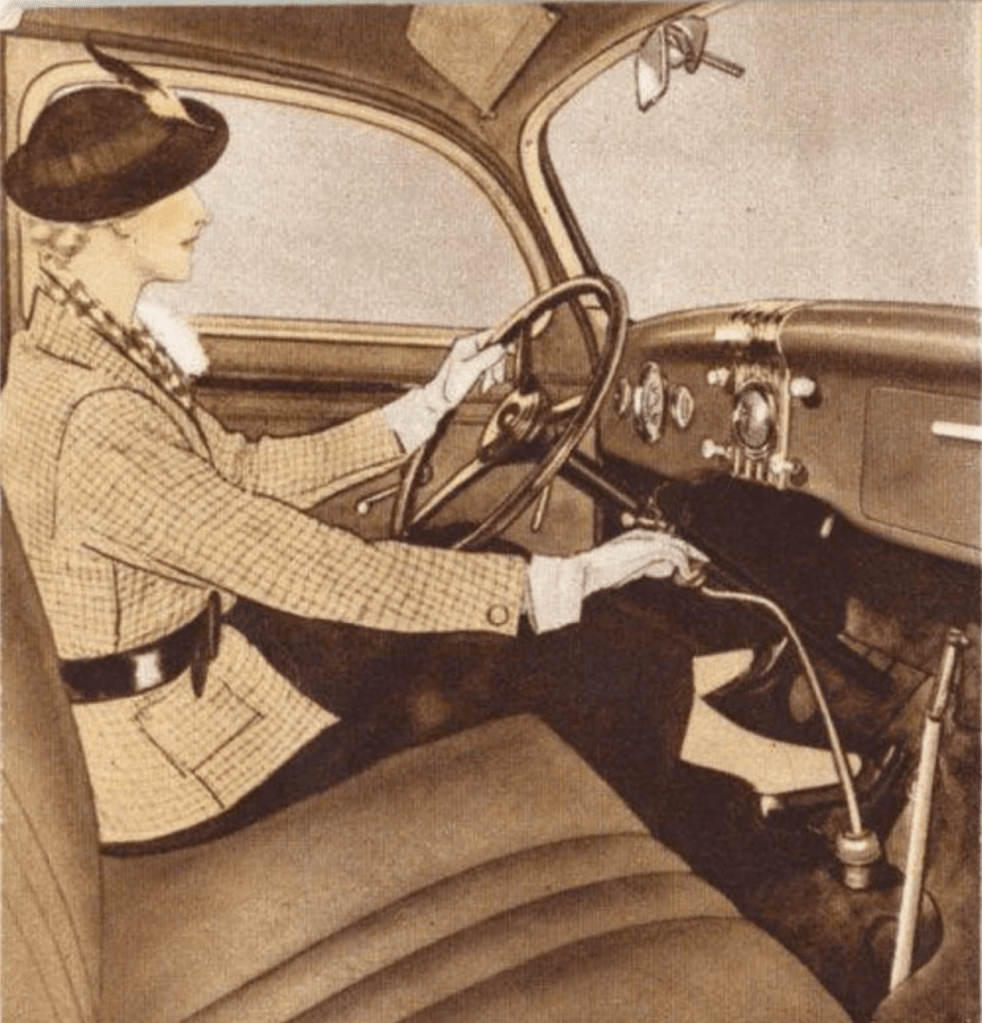
“Well, it’s quite simple.” She had parked her car adjacent to a downtown park, and April’s first warm breezes entered the vehicle through the open windows. The woman unclasped her purse and began to ramble, searching for the one article that would assure her demonstration. Moving aside the peppermint candies, handkerchief, and coin purse, she found the item needed to make her point. Her passenger, with slumped shoulders in his seat, looked confused. “I’ll just be a minute, Hieu,” she assured him. The young man in his twenties had accompanied her since he arrived in the United States a few months earlier. She had helped him find a doctor, obtain the necessary documents for work, and set up his small apartment. During unscheduled times, she made him small cucumber sandwiches and walked him through her garden, pointing out the varieties of roses, camellias, and hydrangeas nestled throughout the yard. Now, the two sat in her 1983 Honda Accord adjacent to Jackson Park; she was the teacher, and he was the pupil. She meticulously searched her pocketbook for her instructional aid, and he sat in silence.
“Oh, there it is,” she yelled, her voice louder than he had ever heard, forcing a small jolt of his shoulders. “I taught this to my sons and grandsons, and Hieu, you’re just like my family.” She retrieved a gold packet and began to shake it vigorously. With the square packet in one hand, she grabbed the stick shit while looking at the passenger and said in a slow and deliberate tone, “This_is_you.” Her passenger looked confused. She continued. “Take_this,” she said, waving the small gold packet in her free hand. She then opened the foiled package and retrieved a small latex ring. Positioning the ring at the top of the stick shift, she quietly began to unroll the sheath with great precision. Her voice was soft and quiet, “Just_like_this.” The last word coincided with the completion of her task. At this point, the passenger was pressed against the closed car door as his body was yearning for a means of escape. She beamed, examining the Honda Accord’s stick shift, now covered in a condom. “That’s how you practice safe sex.”
Mrs. Anne, as we called her, was my mother’s closest friend in the mountains. Like my mother, she was displaced from the Low Country and now lived in a small town in Western North Carolina. Her way of speaking was more subtle, with vowels that took a soft amount of time, a sharp contrast to the bright and quick sounds found in the mountains. Her hair had been cut short since the early 1970s when women looked to the 1920s for sartorial inspiration. She was lean, always in pleated trousers, a simple v-neck sweater, and laced oxfords. She taught teachers at the local college where she regularly pronounced, “Some of you have threatened to teach.” She had spent part of her childhood in Japan because her military father was stationed in Osaka. In the small mountain town, there were hints of Asian influence in her life that could be found in the artwork in her home or an occasional piece of jewelry or scarf. She would serve okonomiyaki and recall stories about her family navigating a foreign culture in the 1950s. When refugees from Bhutan, Cambodia, and Vietnam began settling in Western North Carolina, Mrs. Anne went to work, ensuring countless Asian people could transition to a new country, learn about safe sex, and preserve their Asian heritage.
Asian heritage was not initially crucial to Kenzo Takada. Takada was the seventh child of Kenji and Shizu Takada, who lived and owned a small hotel in Himeji outside of Osaka in 1939. His formative years were during WWII and the aftermath that left Japan in ruins, with cities burning, industry dismantled, basic necessities scarce, and over a third of the country’s wealth obliterated. With so many resources scarce, Takada recalls a childhood consisting of drawing on any surface available, reading his sisters’ fashion magazines, and escaping to American movies that were being heavily imported to all areas of the country. His parents expected their son to enroll at a university, an obligation he fulfilled by matriculating at Kobe City University of Foreign Studies as a student of English literature. After a lackluster year, Takada moved to Tokyo and was the first male student to study at Bunka Fashion College. By graduation, he had earned the school’s So-En Prize and secured work at Sanai Department Store, designing children’s clothing. His exposure to the work of Yves Saint Laurent coupled with the encouragement of Chie Koike, his Bunka mentor who was educated at L’École de la Chambre Syndicale de la Couture Parisienne. His desire for the fashion capital grew exponentially, and when the Japanese government offered Takada ten months’ rent to use his apartment for the 1964 Tokyo Olympics, the young designer was off to Paris.
Takada’s nautical sojourn to Paris took over a month, with stops in Hong Kong, Saigon (Ho Chi Minh City), Singapore, Colombo, Bombay (Mumbai), Djibouti, Alexandria, and Marseille. The journey was serendipitous for Takada and would influence his forthcoming design style, combining myriad cultural patterns and references. For the young designer, the world was beautiful, a phrase that would eventually become the motto for his future label.
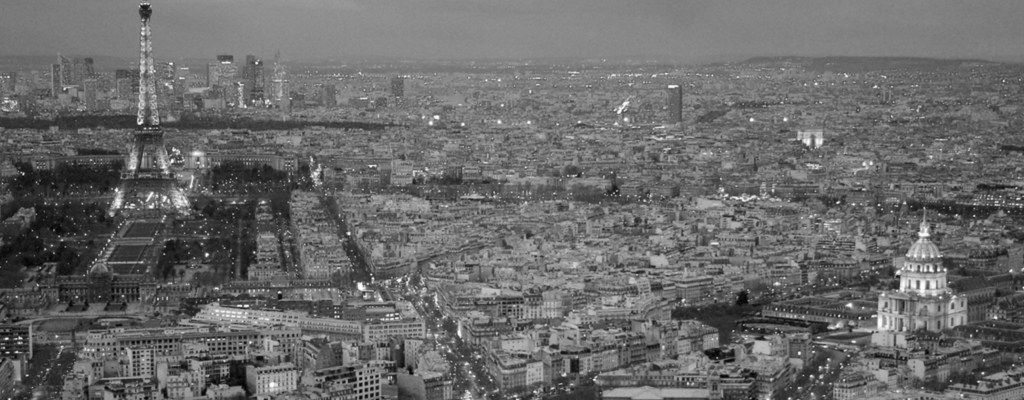
The young designer quickly became enamored with Paris, and an extended 1964 vacation transformed into a permanent residency. Takada quickly enrolled in language classes and produced freelance design work for Louis Féraud before securing a position with Pisanti. Voraciously, he explored the city, taking in the showings from Chanel, Dior, and Pierre Cardin and delving into the various Paris flea markets ripe with global textiles. The city’s nightlife was equally intriguing, and Takada befriended prêt-à-porter designers Karl Lagerfeld and Sonia Rykiel. Takada was enthralled by his life in Paris, and in a letter home to his mother, he expressed:
After all, being admitted into that world is what makes me happiest. Here, in Paris.
While the young designer socialized with Lagerfeld and Rykiel, he explored the exuberant Paris nightlife with Loulou de la Falaise, the muse and jewelry designer of Yves Saint Laurent. The two went out nightly, dancing until dawn and absorbing the swiftly changing French culture of the late 1960s. Younger people in France were longing for a more relaxed culture, a deep enthusiasm for life, and a less restrictive mode of dress. Takada Kenzo and prêt-à-porter would satisfy the youth’s longings.
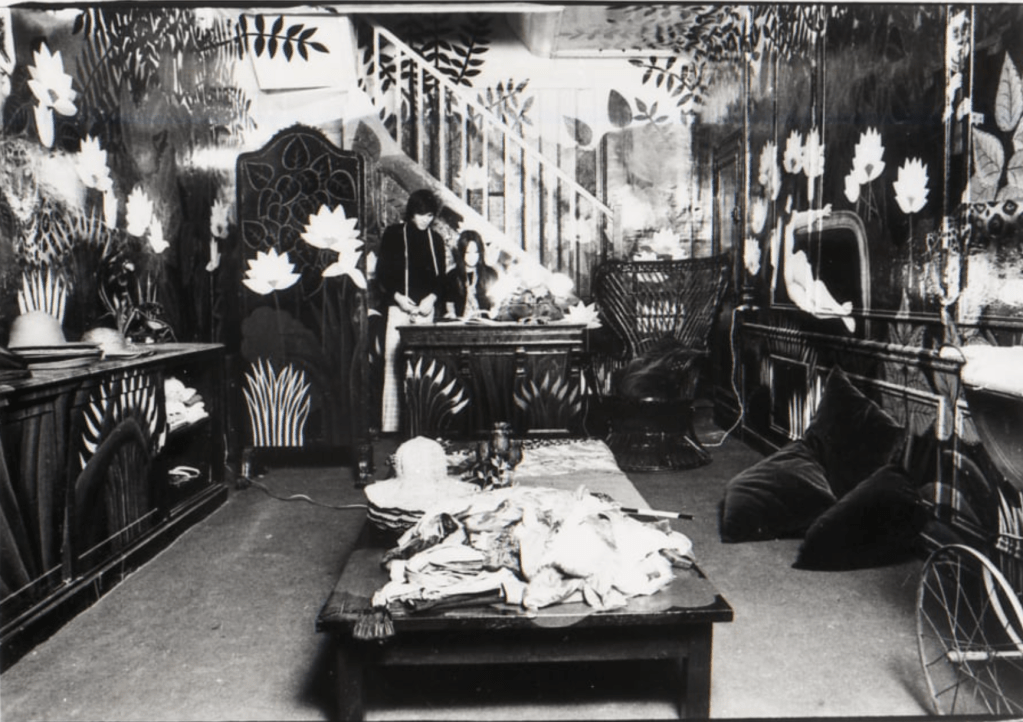
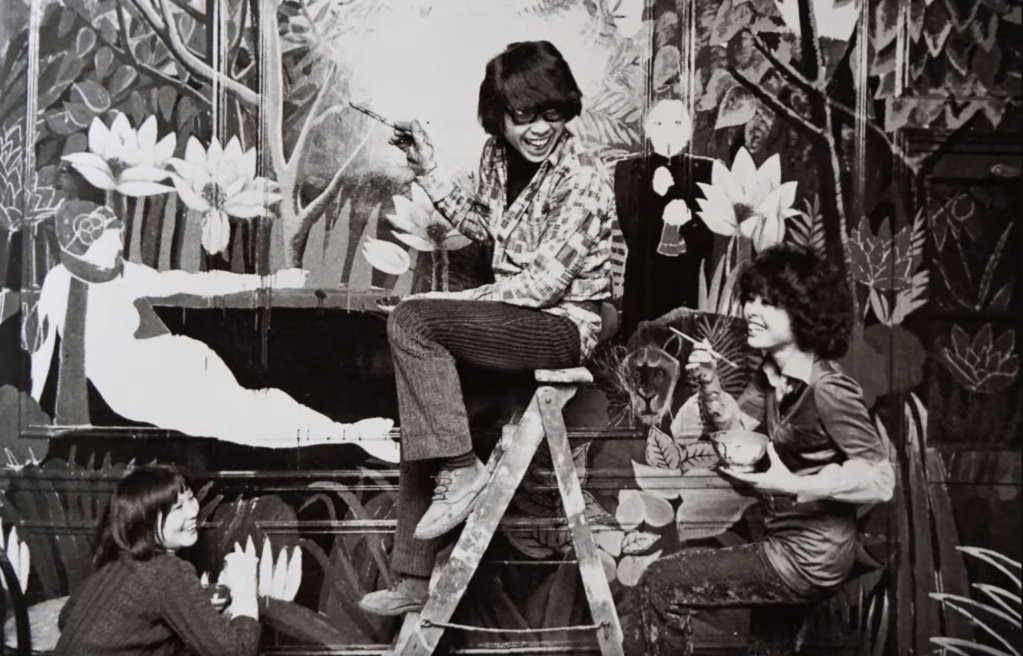
Prêt-à-porter had gained momentum in the past decade, fostered by women entering the labor force, advancement in industry, and the post-WWII youth movements. Taking his inspiration from the changing climate, Takada opened a boutique at 43 Galerie Vivienne. With a limited budget, Takada relied on his talents as an artist and painted the interior based on the works of Henri Rousseau. Takada’s financial constraints were also parameters for his first collection. He relied on textile scraps found at Parisian flea markets and materials he had salvaged from a short visit to Japan, mixing bold materials in oversized garments with few buttons or zippers. The pieces with unique shapes, valiant patterns, and meticulous construction showcased his artistic dexterity and multicultural aesthetic, traits that would define the designer’s clothes throughout his career. Takada’s clothing was the culmination of his experiences as a Japanese immigrant in Paris, combining his vitality with an East-Meets-West approach. The designer called the store and the label Jungle Jap.
Kenzo Takada, miles away from the iconic maisons of haute couture, had an immediate impact on French fashion. Success came quickly when one of his first pieces was featured on the cover of Elle and then featured in Vogue. Within the following year, international buyers would approach the designer, recognizing the appeal of his designs. Expansion was not without difficulty. When the line was offered in the United States, the Japanese American Citizens League Chapter of New York sued the designer for the trademark use of “Jap,” citing its derogatory use in fueling anti-Japanese sentiment. Although Takada argued he could reform the word by associating it with the good and beautiful, he came to realize the history of hurt would outway any of his positive intentions. When his brand expanded with international boutiques, and he opened a new flagship store at Place des Victoires, Takada relabeled the brand KENZO.
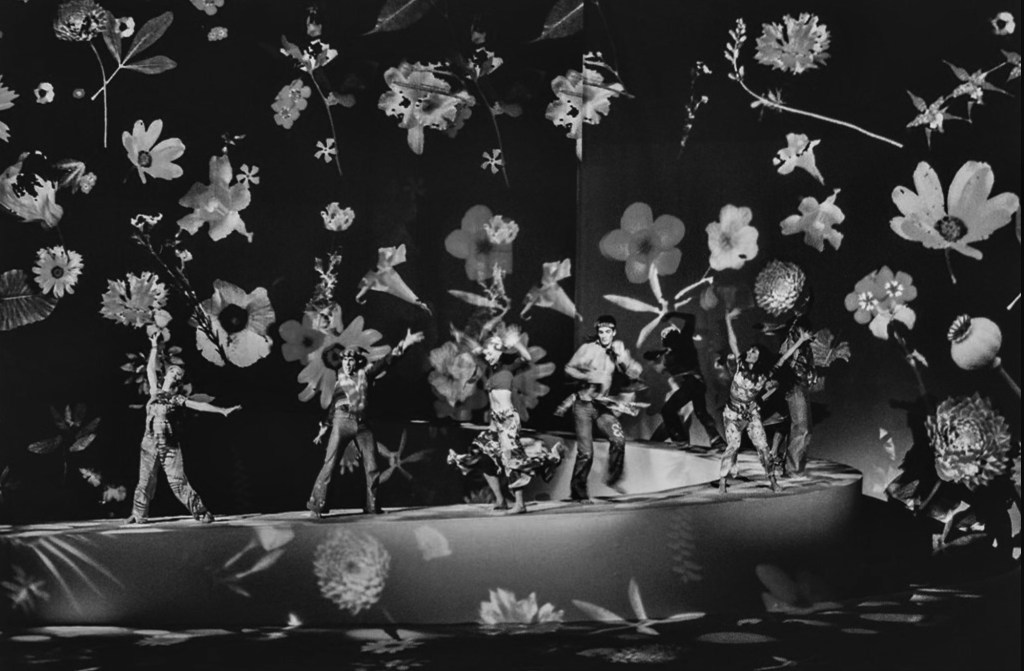
Kenzo’s success was shocking in 1970s Paris, where Chanel, Dior, and Yves Saint Laurent dominated fashion with approaches steeped in taste-making, traditional haute couture values, and exclusivity. Kenzo’s emphasis was the exact counterpoint, emphasizing inclusion, enthusiasm, accessibility, and joy. Editors, buyers, and consumers yearning for the vibrancy and joy found in the multicolored garments flocked to Kenzo. Joan Juliet Buck, who was writing for Interview and WWD at the time, commented,
The KENZO shows were all about mixing things from India, Africa, and Asia. It was never stolid. It was always fun, and it was always with music. It was about making the heart beat faster. Enthusiasm! Excitement
Takada continually drew upon his experiences across the globe and in the Paris club scene for his runway shows, making them the highlight of each season. The extravaganzas were unorthodox performances that highlighted phenomenal settings where models danced and roller skated. One show was held in a circus tent with models in transparent pants on horses while the designer rode an elephant.

Takada Kenzo’s success cannot be discussed without examining his status as a Japanese immigrant in France. Japonisme was first coined in the late nineteenth century as a means to describe Japanese influence on French art and literature. French citizens generally viewed Japanese immigrants through an artistic lens, making them representatives of an exoticized aesthetic while also rendering them invisible. Reducing other aspects of Japanese humanity to a cynosure on art limited the social and economic mobility of many Japanese expatriates. Takada Kenzo was systematically denied entry to the world of haute couture. Working in a realm not created for him would have negated Takada Kenzo’s talent and rendered him invisible. Noting this, the designer once commented, “It imprisons you.” In turn, his design aesthetic embraces a hybridity of his Japanese heritage and the scraps indicative of his immigrant experience. KENZO’s appeal is in its revolutionary approach that simultaneously rejects the established view of the Japanese immigrant and accepts a liminal evolving space outside of haute couture. The result was a democratic line of clothing imbued with the artist’s joy, pan-global sensibilities, and youthful freedom. KENZO flourished and became visible around the world.
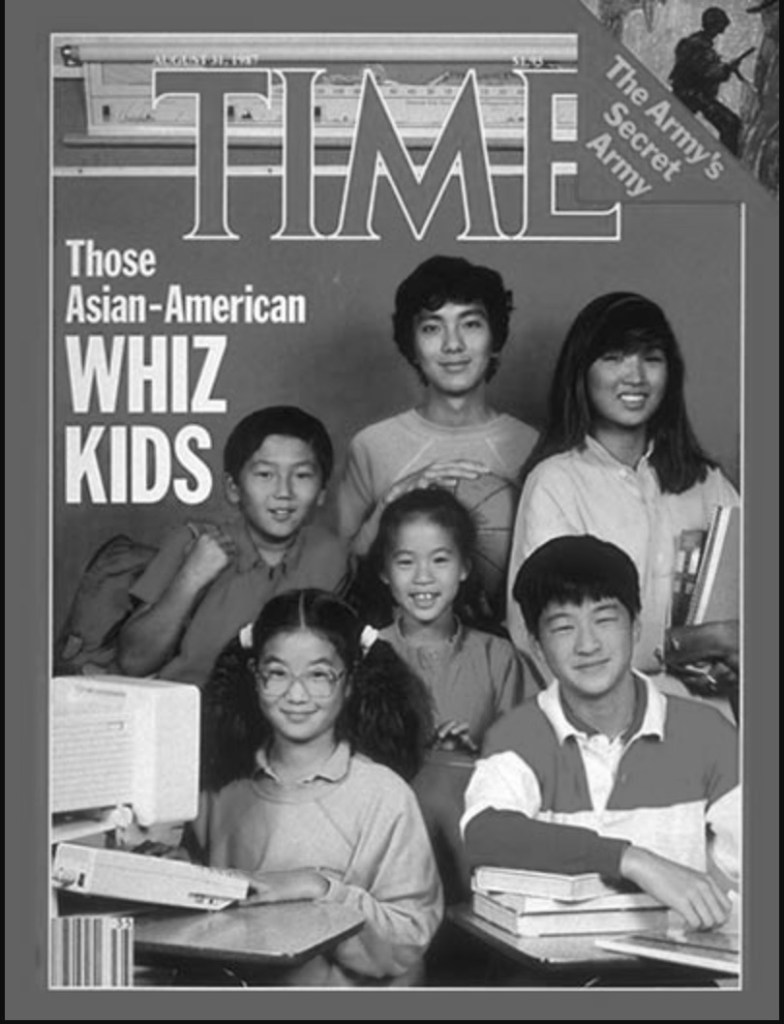
Visibility amongst Asian people in the Western world is a complicated history, especially in the United States. Post WWII found Japanese and Chinese people in a predicament following the internment of Japanese citizens and the demonization of communism in China. Assimilation to the dominant culture offered Japanese and Chinese people access to socio-economic mobility in exchange for their abstinence from traditional culture. During the Civil Rights Movement of the 1960s, the trade-off was used to demonize other underrepresented groups. William Peterson penned the 1966 Success Story, Japanese-American Style, in the New York Times. Peterson, a sociologist at Boston College, expressed that Japanese Americans had risen above any racial discrimination because of educational attainment and economic success. He contrasted Japanese Americans with other People of Color, noting a lack of success was due to poor work ethic and abilities deemed problematic. The idea was furthered in a U.S. News and World Report article, Success Story of One Minority Group in the U.S. The article included Chinese Americans, citing the group as a “model minority” because of their “hard work, thrift, and morality.” Successful integration into American society and self-reliance were the goals, and those not meeting the standards were demonized.

The Model Minority Myth works in multivalent ways, affecting those it describes, those it leaves out, and those perpetuating the idea. When Japanese people were interned during WWII, they received English language tutelage, patriotic lessons, and instruction about behavior in White society. This, coupled with dedicated media coverage, reformed the image of Japanese people in a post-war society. They were no longer the enemy but an exemplary success story. American meritocracy was buttressed, and an industrious demeanor was the hallmark of embracing the Chinese, Indian, Japanese, and Korean people living in America. Besides erasing culture, the idea renders myriad Asian people in the United States invisible. The disparities of over 40 different ethnic groups are erased, masking poverty, incarceration rates, and health inequities. When Mongolian, Burmese, and Hmong people in the U.S. experience high poverty, the model minority myth attributes their hardships to individual culpability while ignoring systemic issues.
While the model minority myth masks many variables within the umbrella term “Asian American,” it is also used to demonize Black communities and other People of Color. When Japanese Americans were released from internment camps, they were instructed to integrate into white society, a move that required distancing not only from their own culture but also from other communities of color. Politicians capitalized on this idea during the Civil Rights Era. Threatened by the demands of equity, the industrious Asian rhetoric was used to discredit Black Americans and their demands for justice. Thriving Asian American communities sharply contrasted struggling Black neighborhoods, attributing the difference to the inferiority of Black citizens. The wedge caused division in the Civil Rights Movement and erased a shared struggle and history between Black people and Asian American Pacific Islanders. The racial hierarchy steeped into the fabric of the United States was reinforced, placing white Americans at the top and Black Americans at the bottom.
With the emphasis placed on mythological rhetoric, systems, and structures that have served as substantial barriers to Asian success have been made invisible. Many students in schools are not taught about The Chinese Exclusion Act of 1882, a ten-year ban on Chinese immigration to the U.S. In the 1960s, when Southeast Asian refugees began seeking opportunities in the U.S., they were resettled in under-resourced and underdeveloped communities, lacking adequate education, health care, and job opportunities. During the era of Urban Renewal, residents of primarily Asian-populated neighborhoods were displaced, making room for new commercial development. This trend continued during the Clinton administration with the passing of the Antiterrorism and Effective Death Penalty Act (AEDPA) and the Illegal Immigration Reform and Immigrant Responsibility Act (IIRIRA). The two laws targeted many Southeast Asians for detention and deportation. In Chinatowns across the country, an influx of luxury real estate development displaces many low-income residents and the businesses and institutions that serve them, triggering a housing crisis and increasing poverty for many Asian immigrants. The focus on the industrious and well-acclimated Asian masks systemic obstructions targeted at all People of Color.
In the United States, KENZO was limited to metropolitan areas of Los Angeles and New York, with additional points of sale at Barneys, Bloomingdales, Neiman Marcus, and Saks Fifth Avenue. The 1980s fueled the expansion of KENZO, opening boutiques, expanding into a men’s line, and developing clothing for children. In the U.S., The Limited carried a capsule line by KENZO, placing his designs in 550 of their stores. By the late 1980s, KENZO launched perfumes, creating various fragrances for all genders. LVMH Moët Hennessy Louis Vuitton acquired the brand in 1993, investing capital that bolstered visibility and profits. Takada Kenzo announced his retirement in 1999, celebrating four decades of reshaping fashion with a retrospective stadium show that featured his last collection. The brand would continue to evolve under the direction of several notable designers, including Carole Lim and Humberto Leon of Opening Ceremony and Felipe Oliveira Baptista. Currently, Nigo of A Bathing Ape is the creative director.
In 1999, while traveling in Europe, I found KENZO at Galeries Lafayette, a modern interior where clothes echoed the movement of my youth. I walked out of the store with a few pieces, including a sweatshirt with the KENZO’s nod to Henri Rousseau’s tiger. There was a very memorable Wednesday night at Le Queen in Paris, where the soulful and vivid Respect is Burning party took place. The deep house music and KENZO pieces were items I imported back to Minneapolis, where I wore them to the dance floors and rooftops, which had been prevalent throughout my twenties.
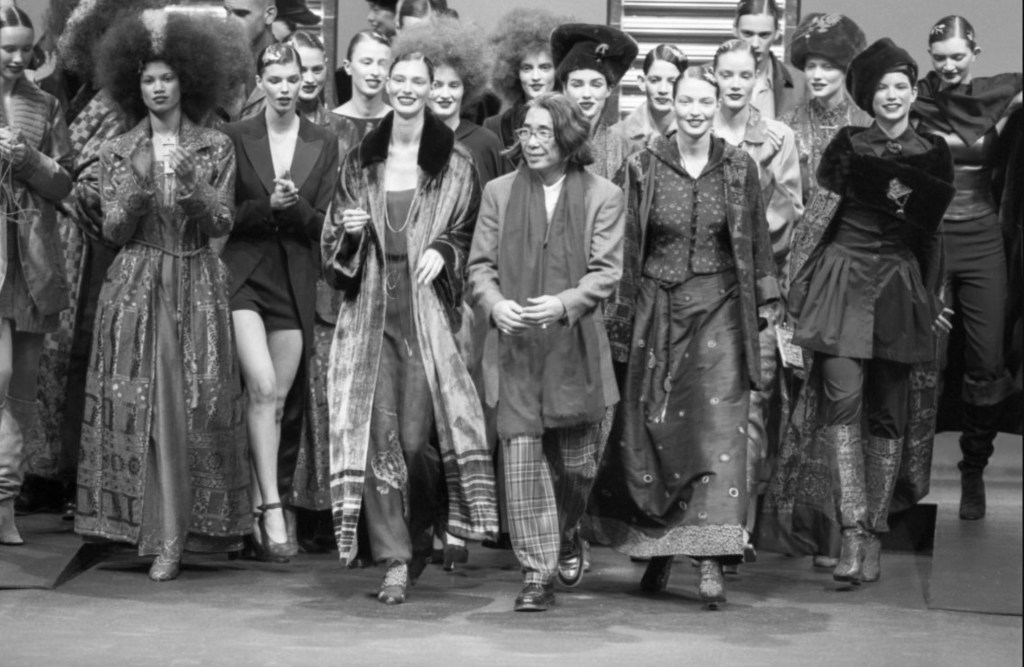
The same tiger sweatshirt from 1999 provided much comfort when the COVID-19 pandemic mandated isolation for survival. A few months into the pandemic, Takada Kenzo died of complications associated with the coronavirus at age 81. In France, Takda Kenzo was always referred to as a Japanese Designer, a title he disliked because he considered himself a designer. In one of his last interviews, the designer reflected on his early career in life in Paris, noting:
When I opened my shop, I thought there was no point in me doing what the French were doing because I couldn’t. So, I did things in my own way in order to be different.
Luckily, Kenzo Takada excelled at doing his own thing, providing the world with an eclectic and sublime aesthetic that brought joy to his clothes, art, and life. Suzy Menkes, the notable fashion editor, commented, “He wanted to make the world happy and beautiful.” He did. Takada Kenzo let us all know that the world is indeed beautiful.
SOUND + VISION: Respect (The 1999 Takada Kenzo Isabella Edition)

This week’s playlist reconstructs a legendary 1999 Parisian night after the last KENZO show at Le Queen’s Respect is Burning.
- Roger Sanchez, Another Chance (Afterlife Mix)
- Blaque, 808
- Sylk 130, The Reason (Featuring Vicki Miles)
- Naughty By Nature, Jamboree (Featuring Zhané)
- Gwen McCrae, Funky Sensation (MAW Mix)
- Tricky Disco, Tricky Disco
- Les, Rhymes Digitales, (Hey You) What’s That Sound?
- Daft Punk, Around The World (Mellow Mix)
- 4hero, Star Chasers (Masters At Work Main Mix)
- Moloko, Sing It Back (Can 7 Supermarket Mix)
- Soulsearcher, Can’t Get Enough! (Jazz-N-Groove Nu Disco Mix)
- Donna Allen, He Is The Joy (Jose Nunes Vocal Mix)
- Masters At Work(Featuring India), To Be In Love (MAW ‘99 Mix)
- Cesaria Evora, Sangue De Beirona (François K Mix)
- Whitney Houston, It’s Not Right But It’s Okay (KCC’s Release The Love Groove Bootleg)
- Funkstar De Luxe, Sun Is Shining
- Basement Jaxx, Miracles Keep On Playin’ (Red Alert Remix)
- Armand Van Helden, You Don;t Know Me (Featuring Duane Harden)
- Cassius, Feeling For You (Reveries Digitales Dreamix)
- Phats & Small, Turn Around (Norman Cook Remix)
- Petalpusher, Breakin’ It Down (Mig’s Bump Deluxe Mix)
- Just A Groove, Nice and Mellow
- Mysterious People, Love Revolution (Mood II Swing Remix 2)
- Eastwest Connection, East West
- Blue Six, Music & Wine (Original Funkaphonic)
- Weekender, Spirit In Your Soul
- Destiny’s Child, Bug A Boo
- TLC, No Scrubs
- Faith Evans, Love Like This
- Warren G & Slick Rick And Phats Bossi, I Want It All (Remix)
- Deborah Cox, One Wish
- Mos Def, Ms. Fat Booty
- MF DOOM, Go With The Flow
- Mobb Deep, Quiet Storm (Featuring Lil’ Kim)
- Dr. Dre, Forgot About Dre (Featuring Eminem)
- Slick Rick, Street Talkin’ (Featuring Outkast)
- Peanut Butter Wolf, Style Crew Flows Beats (Featuring Lootpack)
- T.W.D.Y. Featuring Too $hort & Mac Mail, Players Holiday
- The Herbaliser, Moon Sequence
- Lewis Taylor, Lucky (Kruder & Dorfmeister Suicide Mix)
- Lauryn Hill, Ex Factor
- Nightmares on Wax, Les Nuits
Listen on Spotify, YouTube, or Apple Music
 The Last Boudoir in Angier
Leave a comment