My great-grandmother found churchgoers perplexing. She preferred to stay at home, where she could read her Bible at her leisure and occasionally tell members of her family to go to hell. My grandmother didn’t quite understand the focus on the nuclear family, and she never let obligations stand in the way of her career or travel schedule. My great-aunt thought the battle of the sexes was futile because men were ill-equipped. She once single-handedly shut down an entire company for two weeks when she realized she made less money than her male assistant in 1978. These are the women who raised my mother, and they taught her that dissent was necessary, political, self-preserving, and sacred.
Women have had to dissent to survive. Men have dominated every corner of Western society, rarely allowing entry out of goodwill. During the colonial period of the 17th Century, Anne Hutchinson objected to the theological suppositions of male clergy and began convening parishioners in her home for religious education. Hutchinson paved the way for religious freedom and women entering the clergy centuries later. Not controlling intellectual production or schooling, women gathered at the Wesleyan Chapel in Seneca Falls, New York, in July 1848 to demand the right to education. Their convening laid the foundation for public education and the expansion of universities to include women. The 19th Amendment was ratified in 1920, giving white women the right to vote and paving the way for women to enter the political arena. Women entered the labor force en masse in the latter part of the 20th Century, preferring careers over menial jobs or secondary incomes within the family. With ingress into religion, education, politics, and labor, women began to reshape the culture handed to them by men.

My mother, and many women like her, was the beneficiary of women’s work. By the 1970s, she had a career as a social worker, caring for those who received little attention. She was a fierce advocate for her only child’s education. When I was denied entry into an academic program, she took the fight to the superintendent of schools, telling him he was not fit to drive the Merita Bread Truck (she quickly recanted, noting the Merita Bread Truck driver was useful in the community). She sat on the second row of that very first Baptist church, annually nominating women for leadership positions. She could waltz into the country club looking fabulous while decrying Reagan, segregation, and male-dominated everything. As a mom, friend, and citizen, she defied expectations while doing what was expected of her. She often referred to herself with tongue firmly planted in her cheek as “the failed Southern belle.” Her friends, with part admiration and part confusion, commented, “Well, hon, she just does her own thing.”
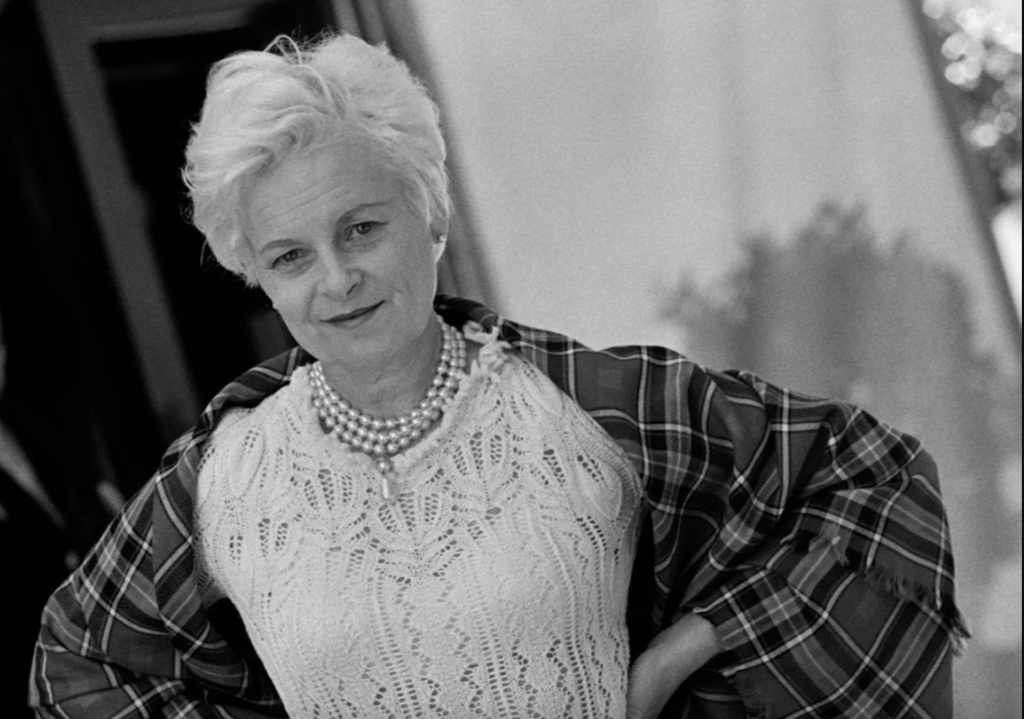
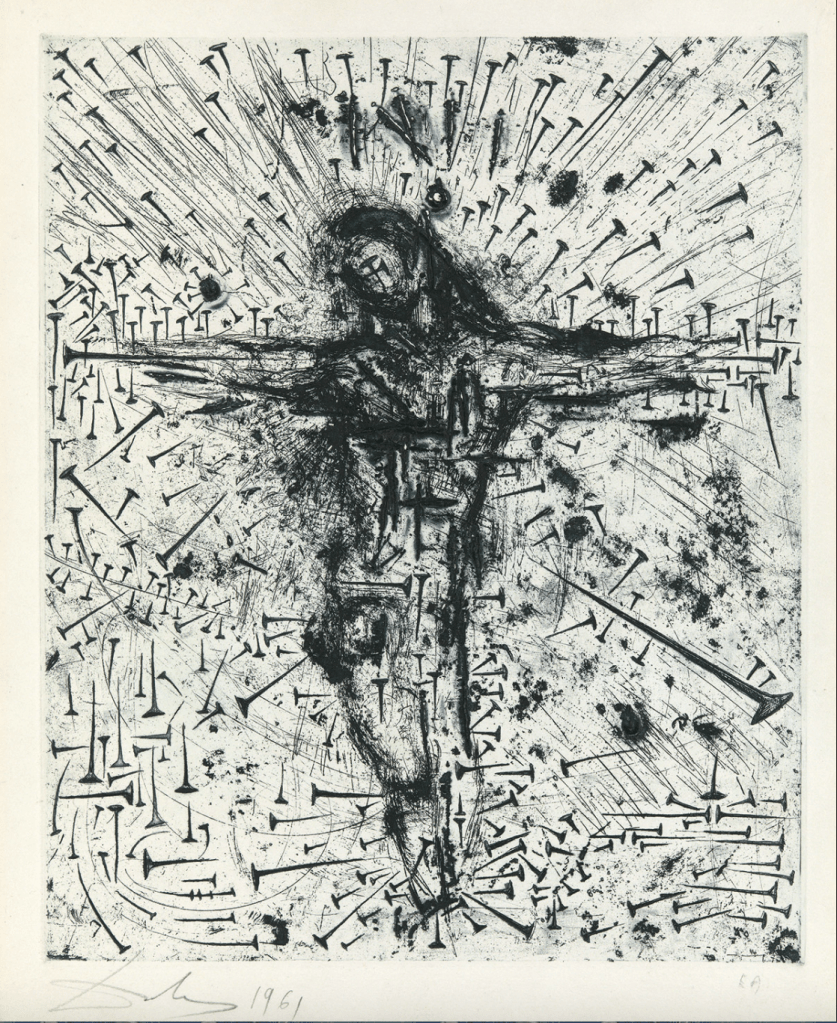
Vivienne Westwood did her own thing again and again. As a child, Westwood recounts a pivotal moment of seeing a painting of the crucifixion. Noticing the explicit violence, surreal imagery, and vivid coloring, the young Westwood felt her parents had not been forthright with her, only conveying stories of the infant Jesus. Westwood was born in 1941 to a working-class family living in the northern village of Tintwistle, an hour from Manchester and a world away from London. The painting revealed the cruelty and hypocrisy of the world. As a child, she realized there was a complexity about society she would have to discover for herself. Often, this journey would lead her to not follow the same path as her peers. Repeatedly, Westwood has noted:
I do feel I’m fighting against conformity.
Not one to easily comply with acceptable ideas and social mores, Westwood would reject many of the roles being handed to women.
From an early age, Westwood was not privy to the consumerist fashion world centered in London, and, as an alternative, Westwood began making her own clothes. Westwood enrolled in London’s Harrow College of Art, studying silversmithing and design. Quickly, she understood the art world was not welcoming to women of the working class and left after one term. She then enrolled at a teacher training college, focusing on art. At the age of 21, she married Derek Westwood and settled into a life of wife, teacher, and mother. The roles were ill-fitting for Westwood, who wanted to explore the broader world and its ideas. She thought the abiding wife, meticulously dressed with her perfectly coiffed hair, living in a pristine suburban setting, awaiting her husband with an admirably prepared dinner, was foolishness. She rejected the ideal marriage and divorced Westwood, retaining only his name. By 1965, Westwood had freed herself. Although this was a substantial feat for any woman born in the post-WWII milieu, her real accomplishment would come in her creation of the future.
The same year of Westwood’s divorce brought Malcolm McLaren into her life. Although many writers convey the marriage and partnership by portraying McLaren as the protagonist, a focus should be centered on Westwood’s agency, ideas, and talents. During this period, Westwood continued her trait as a voracious reader, adding The Compendium Bookshop, Collet’s, and The Marxist Bookstore in Chinatown as regular stops. Westwood, with a singular focus, expanded her intellectual and creative supply. In Lorna Tucker’s 2018 documentary, Vivienne Westwood: Punk, Icon, Activist, Westwood notes about this period of her life:
I was really a woman on a mission. Because I knew I was stupid, and I had to discover what was going on in the world.
This period of Westwood’s growth corresponded with the French student revolution known as Mai 68. The seven-week protests initiated by Parisian students were the first to be broadcast widely on the medium of television. The message of the revolt was seen around the world, and young people outside of France saw the revolt slogans: Demand The Impossible and Imagination Is Seizing Power. The quick and paradoxical nature of the phrases spray painted and graffitied everywhere can be traced to the French Revolution’s anarchy, the political idea aimed to fundamentally change the structure and systems of society. Pierre-Joseph Proudhon, considered the father of anarchism, parsed the idea of anarchy in his 1846 The System of Economic Contradictions or The Philosophy of Poverty, writing, “I destroy and I build up.” Westwood’s keen intellect coupled the French student protests unfolding on television with another French import, The Situationist International.

Founded in 1957 at an Italian conference by academics and artists committed to social reform, The Situationist International aimed to make art and ideas integral to society, not a specialist activity. The philosophy underscored integrated city creation, psychogeography, semantic shifts, and play as a creative activity. Artists were instructed to create situations in urban environments that supported imagination and dissolved the border between art and society, transforming everyday life. Embedded in the ideas was a heavy critique of post-war consumerism that was spreading across Europe and the U.S. The group produced colorful and detailed texts with graphics appealing to the youth movement. By the time the ideas settled in the U.K. and distributed in the short-lived magazine, Heatwave, Westwood was keen to put theory into practice.
The opportunity presented itself at 430 Kings Road in 1971. In the back of the existing shop, Paradise Garage, McLaren and Westwood rejected the hippie movement, heralding the rebellious and raucous nature of 1950s rock ‘n roll from America. Westwood began designing and selling clothes for Teddy Boys, and by November of the same year, the two had taken over the whole store, renaming it Let It Rock. Westwood became unsettled with the conservative and racist politics of the Teddy Boys and began designing clothes to attract a different clientele. Focusing on biker wear, leather, and zippers, the shop used a skull and crossbones in its logo and renamed itself Too Fast To Live, Too Young To Die. Westwood seized the fetish nature of leather and began making and printing t-shirts with provocative images and slogans. By 1974, the shop changed its name again, rebranding as SEX, using the tagline, “Rubberwear For The Office.” When McLaren began managing the Sex Pistols, three of them customers or employees of the shop, Westwood’s philosophical understandings of anarchy as a means to change the world were driving the band, and her designs evolved again, reimagining bondage wear and the deteriorating London cityscape into clothing. The shop was renamed Seditionaries: Clothes for Heroes in 1976, with a brutalist interior and large murals of bomb damage. Journalists and media outlets began describing the goings-on of Kings Road as “Punk Rock.”

With each modification, Westwood was combining her understanding of the political world with her practical craft. Her critiques of Thatcher’s U.K., the disenfranchisement of England’s youth, the abandonment of the working class, and the rejection of socially constructed values outdated and impotent for modernity found a voice in the t-shirts, sweaters, jackets, and trousers she made in the shop. Westwood’s convictions were about changing societal structures, and she was aided by a fierce creative force and a keen mind. When the Sex Pistols imploded and anarchy and punk became marketable in consumer culture, Westwood had a different understanding:
You weren’t really attacking the system at all. It was being marketed all the time. The real marketing opportunity at the time was that English society could claim how democratic and free they were if kids could revolt like that. In fact, we weren’t attacking the establishment; we were just part of the distraction.
Westwood was dissatisfied with the political trajectory and disillusioned with society. She and McLaren reimagined 430 Kings Road as a curiosity shop with a raked floor, a ship-like interior, and a large exterior clock that ran backward, renaming the store World’s End in 1980.
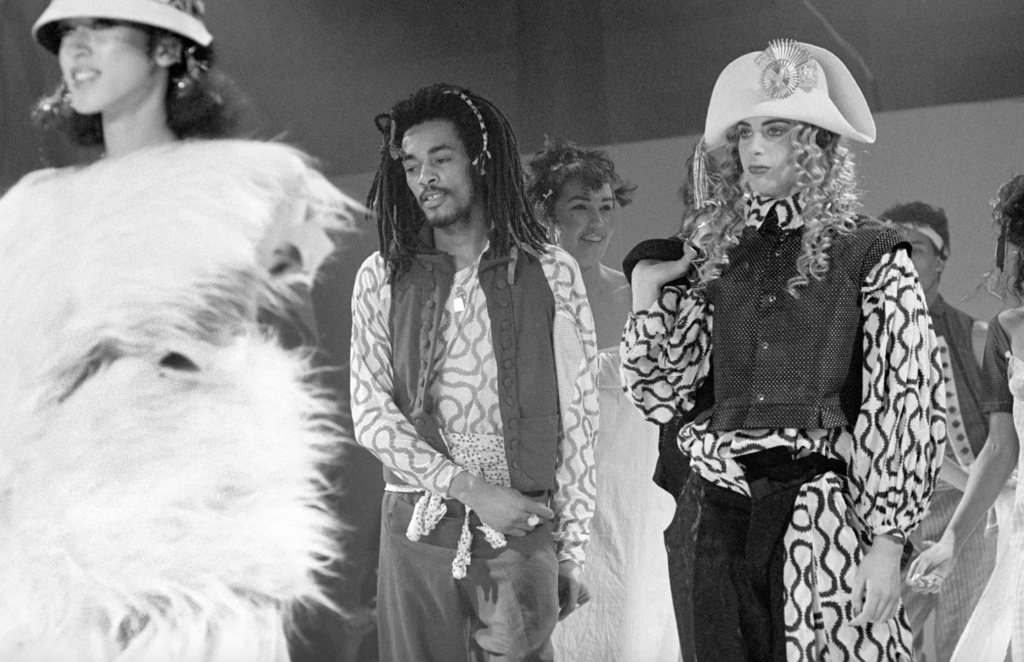
From World’s End, Westwood used the galleon features of the store to present her first runway show in collaboration with McLaren. Westwood’s understanding of plundering underdeveloped countries introduced romantic silhouettes, squiggling prints soon to be one of the designer’s trademarks, and bold colors in a collection called Pirates. The show was well received, influencing the trajectory of Westwood’s career and the fashion industry. Many of the pieces can be found in significant collections, including the Victoria and Albert Museum. Archivists, curators, and critics note this pivotal moment of Westwood’s career for her partnering of historical research with exemplary craft. Taking her notions from Douglas Botting’s The Pirates, the archives at Victoria and Albert Museum, and Norah Waugh’s The Cut of Men’s Clothes, Westwood began experimenting with traditional rectangular cuts. She expanded the geometries, experimented with neck and arm placements, and draping of different fabrics. The effects resulted in dynamic body-centric garments, a signature of Westwood’s style.
By the early 1980s, Westwood had rejected societal ideas and values she found as an impediment to the world she created. Her rejection of McLaren would be significant to her physical survival and future success. The designer’s voracious intellectual abilities combined with her creative capabilities to outpace McLaren’s showmanship, and the two parted ways. The fissure in their abilities and relationship was evidenced in their last collaboration, the 1983 spring-summer collection Punkature.

Westwood, inspired by the futuristic stance of Ridley Scott’s 1982 film Blade Runner and the constant threat of nuclear annihilation, envisioned a collection of everyday clothes for a post-nuclear holocaust. Westwood assumed that starting over would require society to reject notions that caused such disasters, with individual freedoms flourishing to create a new world. Rough seams, unfinished hems, hand-dyed fabrics, and recycled materials populated the clothing, expressing the fulcrum of Westwood’s ideas about punk. Punk was not a style to be marketed as a consumer product but a philosophy to create a vivid world from the destruction around us. Punk and couture were not polar opposites. Punkature was another tool to construct a utopia.
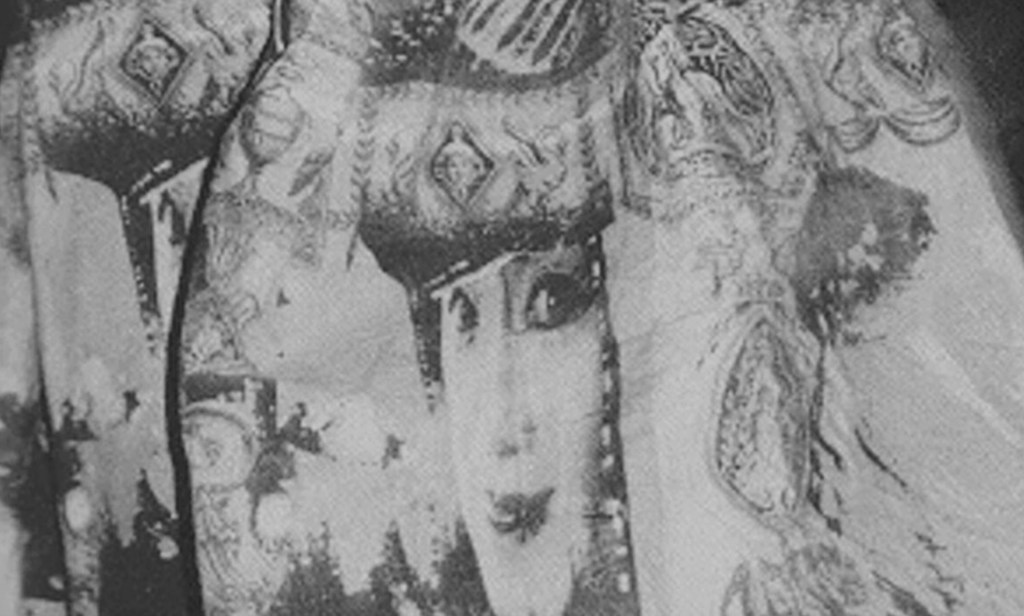
The 1983 Punkature runway show is not the solemn drudgery one would expect to accompany a nuclear winter. Westwood’s show is lively, colorful, futuristic, and joyful. Her obsession with Blade Runner married with an 18th-century toile, decorating shirts and skirts. High-waisted trousers and pants with exposed seams and fasteners complemented oversized jackets embellished with patchwork and large metal buttons. Hats were topless, allowing hair to cascade from the top. Shoes borrowed an idea from the Brazilian slums where people were attaching old cuts from tires to mend broken shoes. On the runway, models, male and female, danced, breathing life into the garments. The clothes are whimsical, flowing, and ornate, making the viewer long for the world presented on Westwood’s runway.
Westwood’s analysis of the Punkature show emphasizes her belief: Punk is a philosophy that enables people to achieve feats once thought impossible. Punk is not a style solely to be emulated and imitated. Punk allows people to be free, controlling their own methods of thought and producing their own culture in the midst of chaos. The soundtrack to the Punkature show supports Westwood’s ideas. She does not harken back to the late 1970s soundtrack of McLaren’s Sex Pistols, the perceived epitome of punk music. She uplifts the electro-funk artist of the Bronx, producing vitality and joy amidst the erosion and racial strife of early 1980s New York City. Visibly exhausted after the show, a journalist asked Westwood how she felt. Her response was simple:
I feel like a giant, and I can do anything.
She was, and she did.
Discovering the Sex Pistols was pivotal during my 1980s teen angst. My cassette of Never Mind the Bollocks, Here’s the Sex Pistols remained in my Walkman often, providing a soundtrack to the discomfort and disdain I felt about life in a small town, being young and queer, and muddling through the Reagan years. I only listened to the Sex Pistols through my headphones because the rage felt sacred, mysterious, and personal. The anger was essential because it was an emotional and biological response to existential threats; it was also not sustainable. Eventually, the energy from fury turns in upon itself and consumes all it meets, leaving nothing but destruction. Too quickly, annihilation becomes synonymous with anarchy, and followers neglect the complete theory that after the tearing down, life must be rebuilt. The anarchy of McLaren and Sex Pistols only produced a partial representation of the theory as they were tearing down systems and structures. Eventually, their rage had devastating consequences, destroying the band and its members.
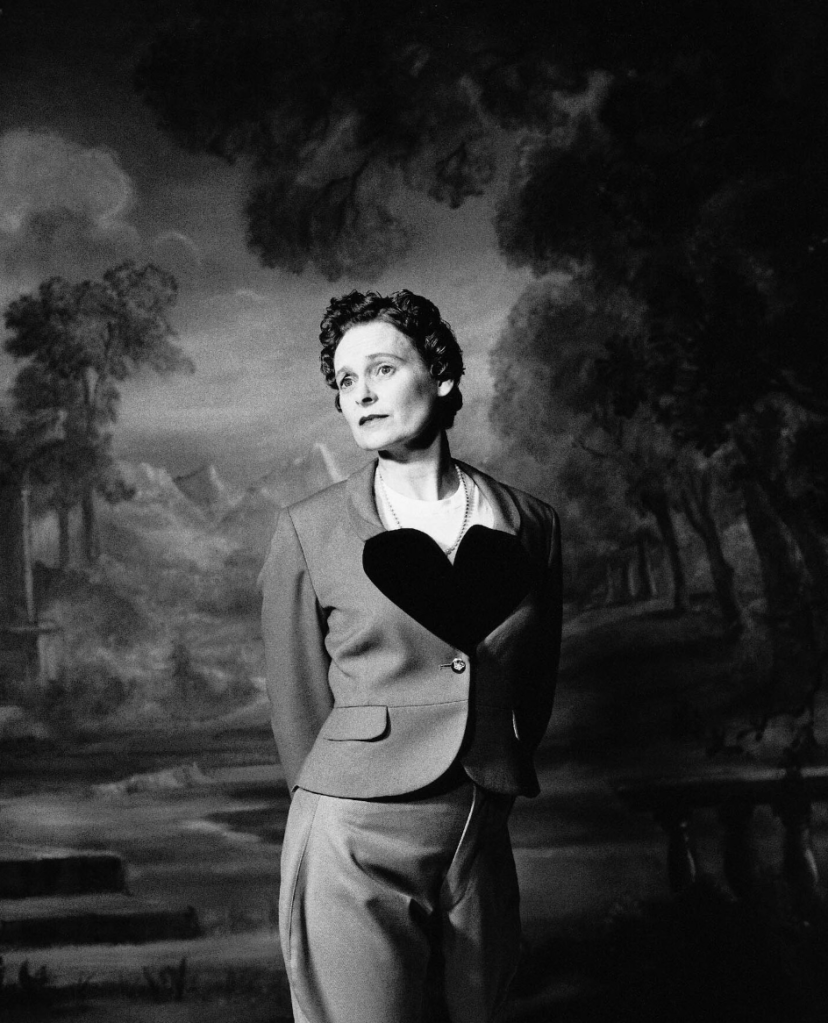
Thankfully, my curiosity led me to Vivienne Westwood. Summarizing Westwood’s life after the punk revolution of the late 1970s as a dressmaker or designer would be an injustice. She was a creator, an architect, a philosopher, a professor, a lover, an alchemist, and a raconteur, continually building the world she wanted to inhabit. My first Vivienne Westwood t-shirt was the revival of The Two Cowboys, and unlike the cloistering of the Sex Pistols cassette, I wore this t-shirt in public often because I wanted a world where sexuality was more acceptable than violence. From there, I added several pieces, each representing a utopia with print, cut, and fabric.
Women have always had to reject the world men too quickly hand them. Dissent is a political and sacred practice, and currently in 2024, there is a great deal to which we should all be saying a resounding no:
- No to this country’s incessant global militarism
- No to a healthcare system that cares more about insurance profits than people
- No to this racialized capitalism that is omnipresent
- No to white supremacy and anti-blackness
- No to schools where children are more likely to get shot than to create
- No to fear-mongering
- No to gender oppression
- No to corporate greed
- No to religious manipulation
- No to total environmental devastation
- No to a deceptive and limiting political system
- No to class warfare
Saying no is critical in our individual and collective lives. However, there is a more significant lesson we learn from women. In the vacuum of nothingness, new life has to be created. Vivienne Westwood knew this, as did my great-grandmother, my grandmother, my great-aunt, and my mother. Their ability to create, against all odds in a society not fashioned for them, made them real giants, ready to take on anything. It made them punks.
SOUND + VISION: Dissent (The mostly 1983 Vivienne Westwood edition)
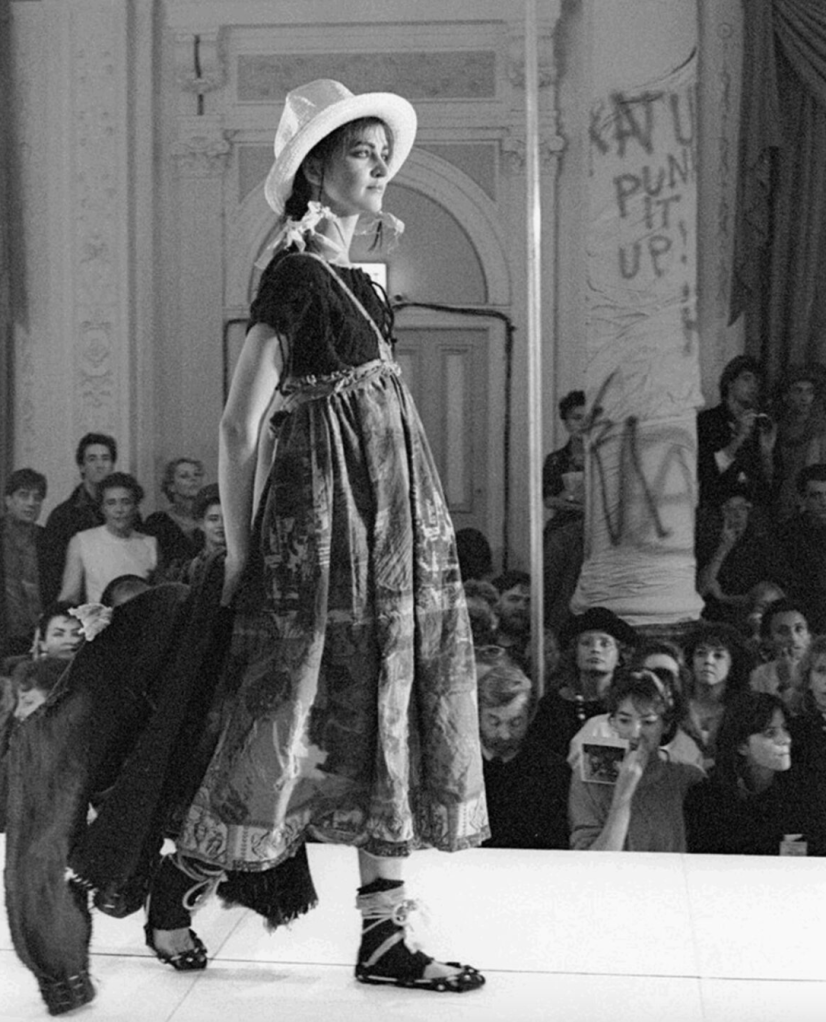
This week’s playlist celebrates the vitality and imagination of Vivienne Westwood, recreating the soundtrack to her pivotal 1983 Punkature runway.
- Last Night A DJ Saved My Life (Acappella), Indeep
- Last Night A DJ Saved My Life (Original 12-Inch Mix), Indeep
- Do It Anyway You Wanna (12-Inch Version), Cashmere
- You Are In My System, The System
- It’s Life (You Gotta Think Twice) (12-Inch Single Version), Rock Master Scott & The Dynamic 3
- Play That Beat Mr. DJ (12-Inch Full Length), G.L.O.B.E. & Whiz Kid
- Al-Naayfish (The Soul), Hasim
- What I Got Is What You Need (Dub), Unique
- When I Hear Music, Debbie Deb
- Let The Music Play (12-Inch), Shannon
- Young Ladies, FAST LANE
- Rockin’ Radio, Tom Browne
- Siberian Nights, Twilight 22
- Egypt, Egypt, Egyptian Lover
- Confused Beats, New Order
- Clear, Cybotron
- Boogie Down (Bronx), Man Parish
- Situation (U.S. 12-inch Mix), Yaz
- Play At Your Own Risk (12-Inch Vocal Mix), Planet Patrol
- No Talking-Lies( Dub), Thompson Twins
- Looking For The Perfect Beat (Original 12-Inch), Afrika Bambaataa & Soulsonic Force
- Don’t Stop The Rock, Freestyle
- Freak-A-Zoid, Midnight Star
- Body Work, Hot Streak
- White Horse, Laid Back
- Take Your Time (Do It Right), The S.O.S. Band
- White Lines (Long Version), Grandmaster Flash & The Furious Five
- Search & Destroy (Arcade Funk A), Trouble Funk
- Cool As Ice (Restructured by John Jellybean Benitez), 52nd Street
- D’Ya Like Scratchin’(Special Version), Malcolm McLaren & The World Famous Supreme Team
- I’m The Packman (Eating Everything I Can) (Instrumental), The Packman
- Wild Girls, Klymax
- Funky Little Beat (12-Inch Mix), Connie
- Jam On Revenge (The Wikki Wikki Song), Newcleus
- The Smurf, Tyrone Brunson
- Space Cowboy, Jonzun Crew
- Street Justice (12-Inch Single), The Rake
- Adventures In Success, Will Power
- Legba, Malcolm McLaren
- The Soul Awakening, China Crisis
Listen on Spotify, YouTube, or Apple Music
 The Last Boudoir in Angier
Leave a comment