“We gotta do something.” The phrase was my universal response to the world around me. My entry into politics began at Hendersonville Junior High School when I was appointed as a class representative on the student council. As a new student, I can only be convinced my assignment was my teacher’s effort to help me transition into public school life. Every Tuesday afternoon, a gaggle of acne-prone, hormone-raging, voice-cracking preteens gathered, the fate of the student body in their hands. While I thought my service was needed to provide insight into the academic and social life of the burgeoning American adolescent navigating the 1980s, in reality, the council only made decisions about scheduling a school pizza party, relegating the days students could have chocolate milk, and planning the theme to the school dance.
By the time I entered high school, I better understood the power wielded by a political body. If life had been made more pleasant by securing Jimmy’s pizza for a school-wide celebration and increasing the availability of chocolate milk in the cafeteria, then undoubtedly, high school students could implement more substantial and wide-reaching changes. The Tuesday afternoon meetings of junior high were exchanged for an early morning meeting time, an hour when a teen body, at best, was drowsy. Not dissuaded by the seven o’clock start time, I was ready with a cache of investigated topics for discussion when the student council president weekly inquired, “Is there any new business?”
- Graduation rates have steadily decreased in the past five years. What should we do?
- The school board has proposed cutting funding for the arts. What’s our response?
- The chemistry lab needs new materials. How can we help?
Each week, I proposed an issue desperately needing attention, and each week, I gazed around the room at the microcosm of mid-1980s teen life. The overly anxious nerd, twitching from left to right, shuffling loose papers and longing for acknowledgment; the peppy captain of the cheer squad scribbling in their diary with a fuzzy-hair topped pen in electric blue; the thespian draped in shades of black and barefoot, closing tight eyes to signal deep thought; the well-coordinated socialite, intently gazing into a compact for an out-of-place hair; and the stoner dressed in an oversized AC/DC t-shirt and ripped jeans, reposing limply in a rigid chair seemed to not hear my weekly litany of pressing issues. Finally, I would break the silence, “We gotta do something.”
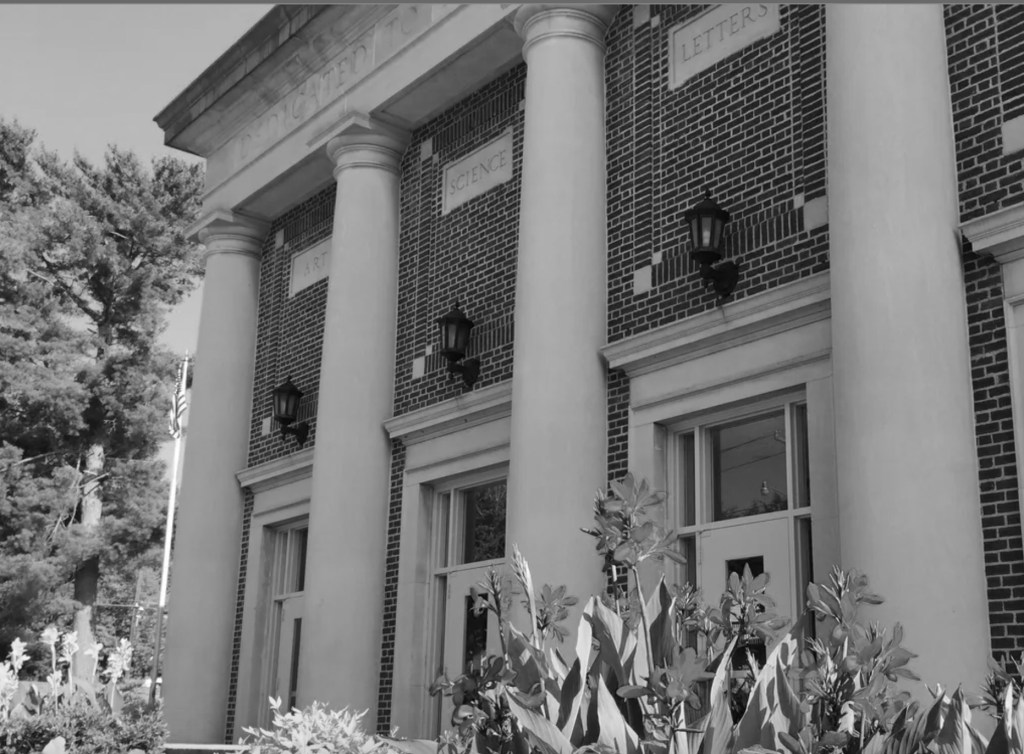
Political apathy is not confined to high school students. In a country where candidate advertisements are nonstop, there is a pervasive sense of indifference toward politics. Journalists and scholars devote ample space to charting the populace’s lack of psychological involvement in public affairs, emotional interest in civic duties, and physical engagement in elections. Polls cite low voter turnout, and reports underscore the amount of citizens unfamiliar with federal, state, and local representatives. One source can designate an aging population as the cause for political apathy, while another blames voters 18 -24 for low participation. Think tanks break down the phenomenon on racial lines, gender differences, and sexual orientation. The Harvard Gazette cited political apathy as the country’s most looming threat, and The Pew Research Center is a constant reminder of our political exhaustion.
When discussing political apathy, thinkers refer to the United States’ founding as the hallmark of civic engagement. The Federalist Papers proclaim that the newly forming government should have a shared interest with the people, citing the relationship as an essential tool of liberty. The writers continue, underscoring that “frequent elections are unquestionably the only policy by which this dependence and sympathy can be effectually secured.” Using this idea from the Founding Fathers, people have assumed past epochs have bolstered public engagement with vigorous and record participation in the political process. Scholars have reinforced this idea, proclaiming that the political engagement of the 18th and 19th centuries in the United States was so pronounced that it became a natural lens through which to view society. American historian and Harvard professor William E. Gienapp upheld that political elections were more attended than religious services and that “political life formed the very essence of the pre-Civil War generation’s experience.”

The early writings focusing on democracy purport to champion an engaged citizenry. Modern scholars romanticizing early America as a period of record high political participation is riddled with grave lacunae. Primarily, voting was the right of elite white men. Property ownership was equated with an economic stake in society and the right to vote, disqualifying many white men living in poverty. The land-owning caveat was eliminated by 1840, providing 90% of white men the vote. The 19th Century also denied suffrage to free Black men. The Fifteenth Amendment in 1870 did give Black men the right to vote, but it also provided states the ability to determine the qualifications for voting. Literacy tests, poll taxes, and grandfather clauses continued to exclude Black men and poor white men from voting. This practice continued well into the 20th Century. Before 1920, women were not permitted to vote in the U.S., and after the ratification of the Nineteenth Amendment, only white women over the age of 21 secured voting rights. The Indian Citizenship Act was passed in 1924, granting Native Americans the right to vote. Black women would not secure the vote until the Voting Rights Act of 1965. Early periods may have had high engagement in politics, but that involvement was exclusively white and male, disqualifying the majority of the population.
Examining newspaper articles and demographics from the 19th Century, we find social stratification played an essential role in who could and could not be politically active. Laborers in agriculture and industry were often too busy and too tired to attend caucuses, meetings, and conventions. Time and mobility, the luxuries of the elite and professional classes, made exercising civic practices easy. Glenn C. Altschuler and Stuart M. Blumin noted that the social mobility that guaranteed individual voting rights did not secure party involvement, and political parties did not rely on the civic conscience to drive people to the polls but instead used organizers and treats such as whiskey to make sure they voted. In light of these facts, modern political society is no different from the country’s earlier days. Their restrictive voting laws have transformed into modern district gerrymandering, disenfranchising voters. Literacy tests and poll taxes have evolved to Voter ID requirements and fewer polling places. The American laborer is overworked, providing time and resources for the elite. Political apathy is not a modern occurrence laid at the feet of the individual; it is a by-product of the U.S. political system designed to limit participation. Understanding this arrangement, there have always been individuals who were deeply committed to political affairs, working hard to persuade those who could not and offering a rallying cry.
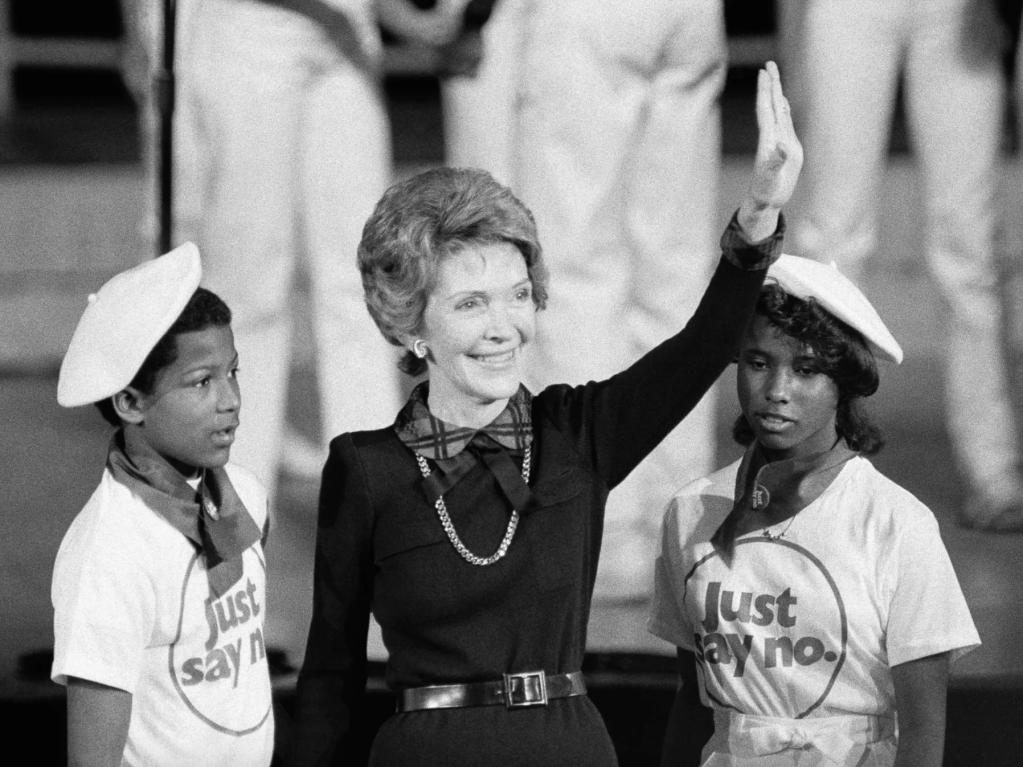
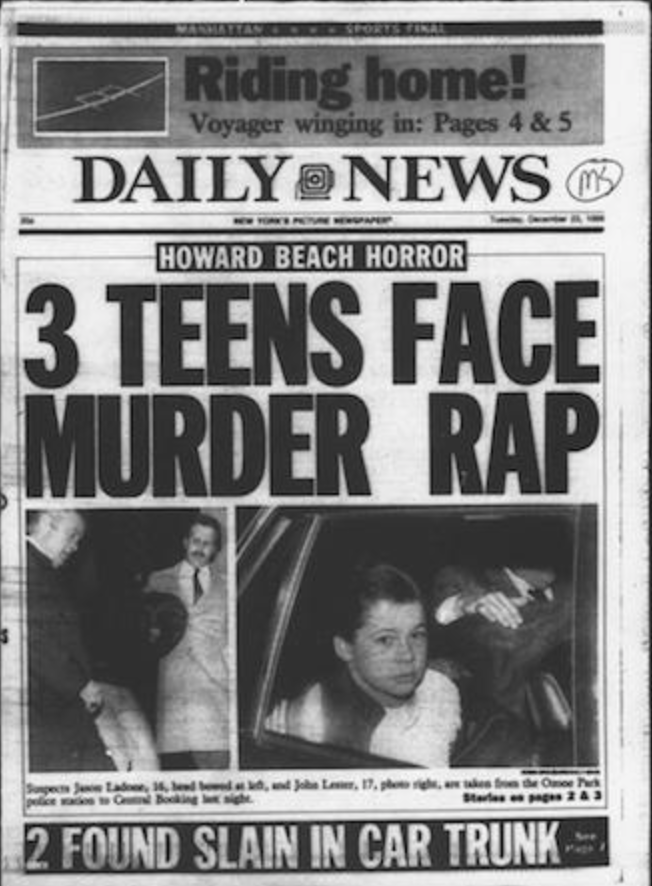
1986 needed a cri de coeur. By the second term of Ronald Reagan’s presidency, the country had made a bleak shift. The Iran-Contra Affair made shambles of U.S. foreign policy, bringing daily scandals that revealed the duplicity of Reagan’s public facade with his private dealings. Nancy Reagan’s “Just Say No” campaign did little to curtail the rise of overdoses but laid fertile ground for the imprisonment of Black men with the War On Drugs. Foreign policy also suffered when the nuclear arms control talks between Reagan and Mikhail Gorbachev at Reykjavik in Iceland failed. People questioned the expertise of NASA after witnessing the public and sensational explosion of the Space Shuttle Challenger, resulting in the death of seven astronauts. The administration failed to address the AIDS epidemic, and The Centers For Disease Control announced that with an 89% increase in cases, more people were diagnosed with AIDS than in all earlier years combined. The explosion of the Soviet nuclear plant in Chernobyl was the most devastating disaster in the nuclear age and led to disturbing facts about America’s own outdated and under-resourced facilities. Four days before Christmas, a group of white men unprovoked attacked three Black men outside a pizza parlor in Howard Beach, Queens, resulting in severe beating, death, and again exposing America’s racial animosity. The Ivan Boesky Affair revealed the corruption of Wall Street insider trading cases in the nation’s most recognized brokerage and investment firms. By the end of the year, The Yuppie Five, five professionals from prestigious financial institutions with elite college degrees and connections to exclusive social clubs and circles, were indicted for insider trading. In an end-of-the-year summary for The Washington Post, Haynes Johnson stated, “For Americans, 1986 was a year when things suddenly and inexplicably went wrong.”
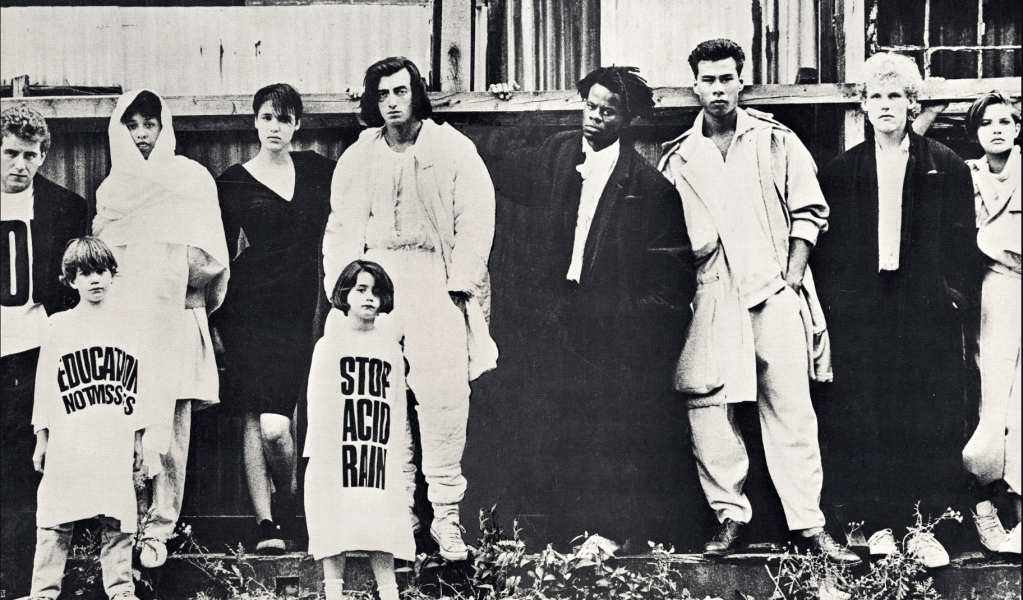
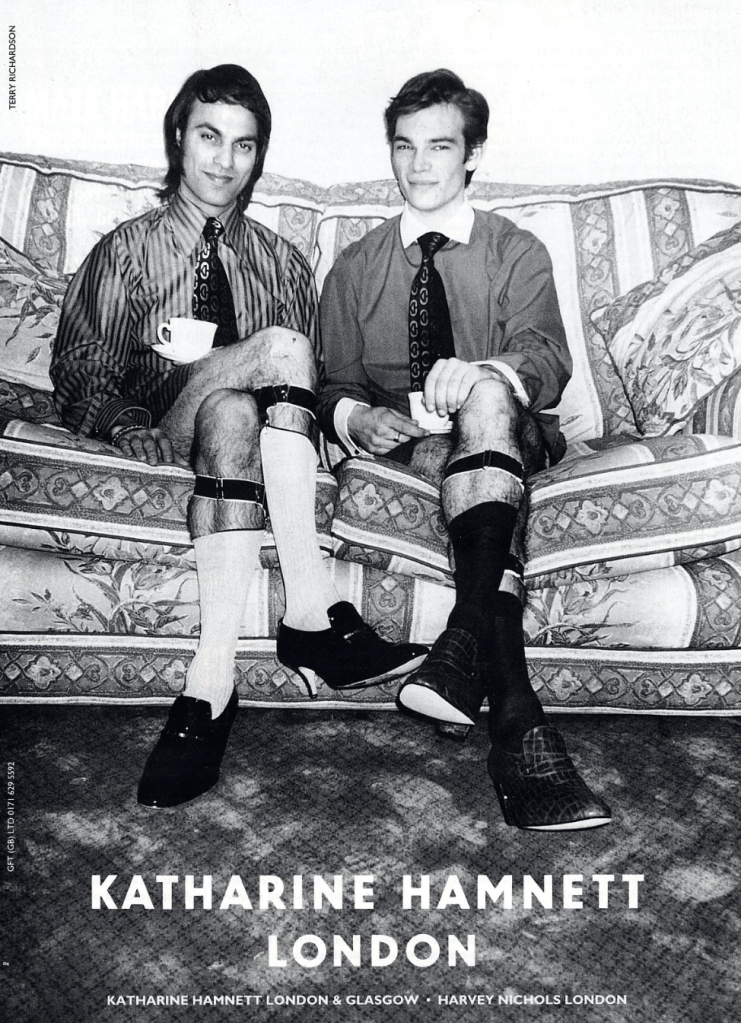
Katharine Hamnett was dubbed the Jane Fonda of fashion in a 1986 New York Times article reporting on London Fashion Week. Before the pronouncement in American newsrooms, Hamnett had a steady climb. The designer graduated from the prestigious Saint Martin’s School of Art in London and started her first line, Tuttabankem, with a school friend. After the partnership ended, Hamnett worked as a freelance designer in Tokyo and Paris before returning to London and launching her eponymous line in 1979. Katharine Hamnett began heralding a style that was both utilitarian and chic. Within a few years, the collection was available in 700 retail stores and 40 countries, appealing to the fashionable and famous. Hamnett highlighted Ellen von Unwerth, Juergen Teller, and Terry Richardson in their early commercial careers while giving a start to Claudia Schiffer, Nadja Auermann, and Naomi Campbell in her fashion shows and advertising. Hamnett became the first recipient of the British Fashion Council’s British Fashion Designer of the Year. By early 1982, Hamnett began aligning her values with her fashion brand, offering oversized t-shirts displaying political messages in bold typeface. Hamnett’s political t-shirts earned her the reputation as fashion’s bad girl with integrity.
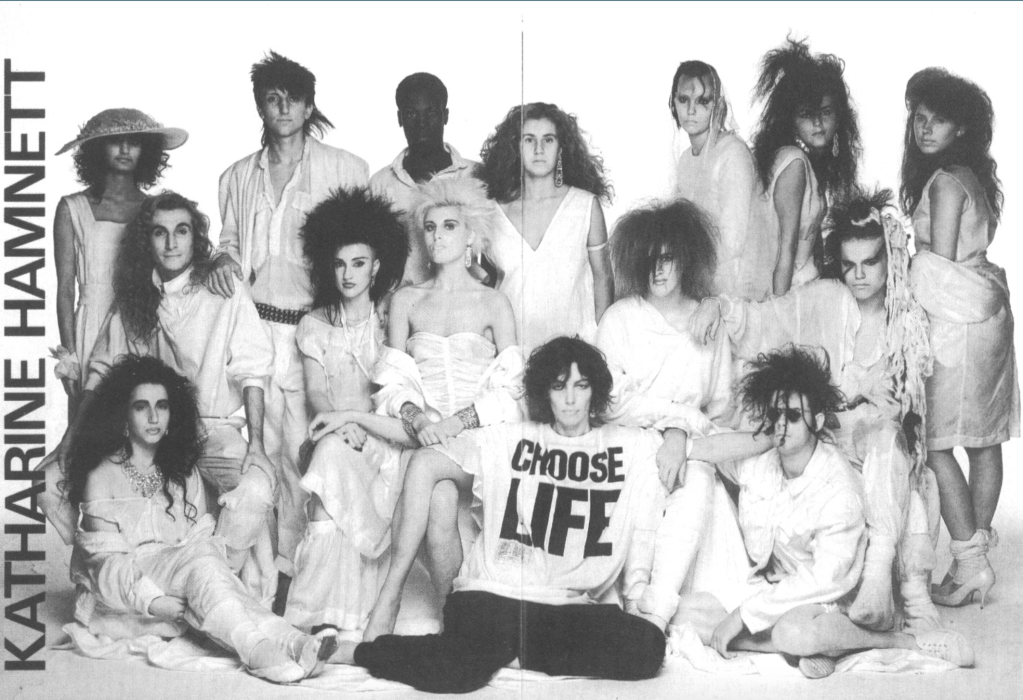
While Hamnett was known by the fashionably conscious of Europe, she soon became an international sensation when George Michael and Andrew Ridgely of Wham! wore her CHOOSE LIFE t-shirt for their international hit “Wake Me Up Before You Go Go” in the spring of 1984. The phrase was a tenet of Hamnett’s practice as a Buddhist and a reaction to the threat to life by AIDS and nuclear disaster. The designer wove these political t-shirts into her brand’s ethos, featuring her unpretentious denim and knits with slogan tees. Hamnett noted,
I wanted to put a really large message on T-shirts that could be read from 20 or 30 feet away because slogans work on so many different levels. They’re a way of people aligning themselves to a cause.
The designer was not timid about positioning her politics in the fashion spotlight.
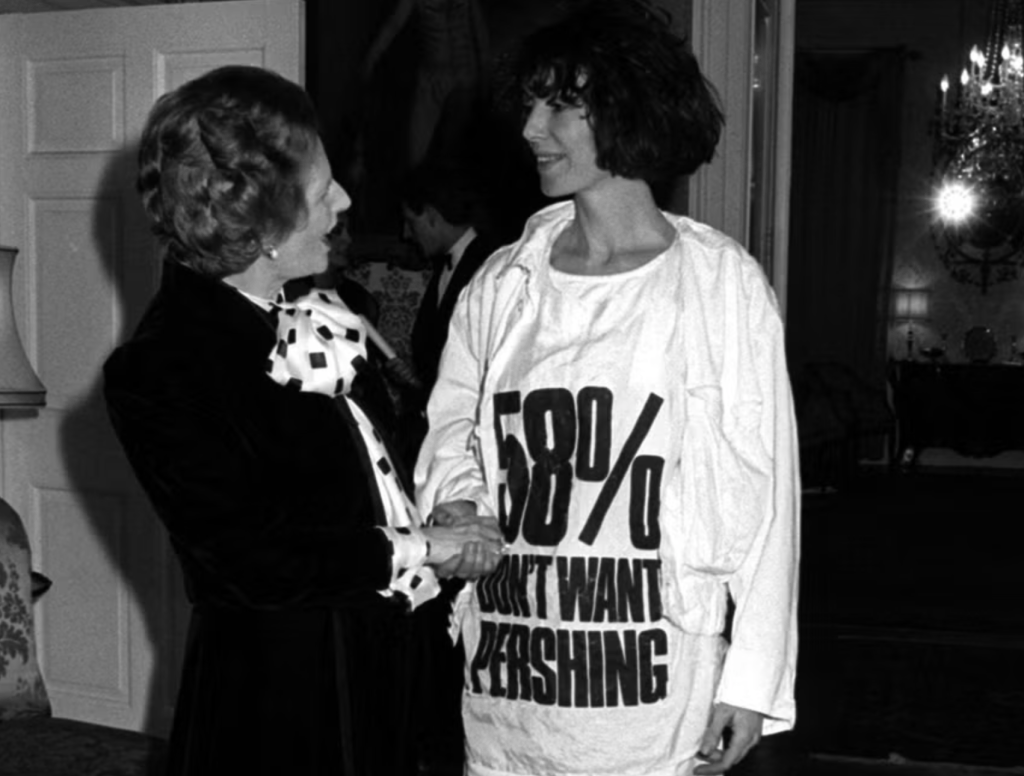
In the same year Wham! was dancing in Katharine Hamnett t-shirts, the designer was invited to a reception at 10 Downing Street to meet conservative Prime Minister Margaret Thatcher. Realizing the press would be present, Hamnett suppressed her desire not to go and realized the moment to make a statement. Katherine Hamnett wore a t-shirt reading, “58% DON’T WANT PERSHING,” a statement reiterating the public opposition to Thatcher granting the U.S. permission to station nuclear missiles in England without the consent of the electorate. After an initial greeting, Thatcher squawked at the message and avoided Hamnett for the entirety of the evening. The picture of the two women shaking hands with a visibly startled Thatcher made the front page of international papers and magazines. The designer’s t-shirts were a much-wanted commodity and were spotted on Mick Jagger, Boy George, Annie Lennox, Liz Taylor, and Madonna. She expanded her repertoire of slogans, including PROTEST AND SURVIVE, STAY ALIVE IN 85, VOTE STRAIGHT IN 88, NO WAR, EDUCATION NOT MISSILES, CLEAN UP OR DIE, and SAVE THE FUTURE.
Katharine Hamnett was more than a fashionable town cryer, churning out pithy slogans. She was an active and conscious member of the populace willing to take action. As her fashion notoriety became more prevalent in the mid-1980s, Hamnett began to investigate the logistics and mechanics of the fashion industry. Prior to her education, she noted that her initial business solely focused on making fashionable clothes without realizing the consequences of production:
And I was the original spoiled brat. I just wanted to make clothes that were exquisitely beautiful, and I didn’t care what they were made of. It was a time of total innocence – and, yes, ignorance. We were just having a lovely time, but, in actual fact, we were all guilty.
She discovered every part of the garment industry had devastating effects, including 20,000 annual deaths due to pesticide poisoning from conventional cotton agriculture, climate destruction of forests, and pollution of aquifers. In the late 1980s, she released the Clean Up or Die collection, adhering to sustainable practices and addressing the climate crisis. Besides using her runway for political statements, she lobbied relentlessly for political and social change. The results changed not only her and the way she did business but also the industry. Recalling her stance, Hamnett stated, “I just got really fed up; it’s about show not tell.”

Katharine Hamnett has continued her political stance, featuring The Grey Organisation on her catwalk and calling for a ceasefire in Gaza. My first Katharine Hamnett t-shirt was VOTE. Like most of Hamnett’s block print t-shirts from the 1980s, the message seems just as pertinent today. Like Hamnett, I know that people cannot resist reading the large-letter slogan, and I hope the message remains in their brains. I also know the message requires action. My Hamnett t-shirt collection expanded, aligning my actions and political thought. STAY ALIVE IN 85 and NO WAR entered my sartorial lexicon, coupling with CLEAN UP OR DIE and a vintage CHOOSE LIFE.
By 1986, my time on the high school student council was supplemented with my school’s literary club, a group of teenage wannabe poets and novelists aching to make a change with words. The club hosted impromptu poetry slams for the student body, attended local and state conferences dedicated to writing, submitted editorials to the local paper, and published an annual literary magazine. While the student council was planning spirit days and sock hops, the aspiring literati were penning “When The Acid Rain Melts My Snowman,” “Hiding Under My Desk Waiting For The Bomb,” “Just Say Yes,” and “Failure To Care.” While the political body failed, the populace knew doing nothing would never be an option.
Sound + Vision: Choose Life (The Katharine Hamnett Edition)
This week’s playlist revisits the angst, joy, protest, posturing, synth, and soul of 1986 with some rarities, reliables, and raucous records.
- Stripped (Highland Mix), Depeche Mode
- Stairs And Flowers (Dub), Skinny Puppy
- Rise, Public Image Ltd.
- Massive Retaliation, Sigue Sigue Sputnik
- Rock Me, Amadeus (12-inch American Mix), Falco
- Rumors, Timex Social Club
- Ain’t Nothin’ Goin’ On But The Rent (Extended Club Mix), Gwen Guthrie
- Serious (12-inch Extended Mix), Donna Allen
- West End Girls (Dance Mix), The Pet Shop Boys
- Baby Talk, Alisha
- 7 Ways To Jack, Hercules
- Turn Me Loose, Wally Jump Jr.
- The Pleasure Principle (Long Vocal Shep Pettibone Remix), Janet Jackson
- Hey Rocky! (Instrumental), Boris Badenough
- It’s Ticky (Club Remix), Run-DMC
- I Can’t Turn Around (House Mix), J.M. Silk
- Bizarre Love Triangle, New Order
- Oh L’Amour (The Funky Sisters Mix), Erasure
- Boom Boom, Paul Lekakis
- We Don’t Have To Take Our Clothes Off (Special Extended Mix), Jermaine Stewart
- No No Love (1987 Mix), Rhonda Paris
- Bad Times (I Can’t Stand It), Pt. 1, Captain Rapp
- Pay Me Back My Love, Colors
- Jump Back (Set Me Free) (Club Mix), Dhar Braxton
- Saturday Love (12-inch Mix), Cherelle & Alexander O’Neal
- Boy (Extended Version), Book Of Love
- Cities In Dust (Extended Version), Siouxsie & The Banshees
- Trapped (12-inch Vocal Regisford Mix), Colonel Abrams
- Holding Back (Vocal Mix), Paradise Girls
- Get It Girl, 2 Live Crew
- Word Up (12-inch Vocal Version), Cameo
- I’m Not Perfect (But I’m Perfect For You), Grace Jones
- Musique Non-Stop, Kraftwerk
- Breakout (N.A.D. Mix), Swing Out Sister
- Mine All Mine (Extended Version), Ca$hflow
- Paranoimia (Featuring Max Headroom) (Extended), Art Of Noise
- Don’t Waste My Time (The Breakers Mix, Pt. 1), Paul Hardcastle
- Diggin’ Your Love (12-inch Mastermind Mix), The Blow Monkeys
- Higher Love, Steve Winwood
- (Forever) Live And Die, Orchestral Maneuvers In The Dark
- Hungry For Your Love (Dub), Hanson & Davis
- Human (Extended Version), The Human League
- Nights of Pleasure, Loose Ends
- It’s Been So Long (Extended Remix), Melba Moore
- I Can’t Wait (Go remix), Nu Shooz
- Love You Down (Extended Remix), Ready For The World
- Sometimes It Snows In April, Prince
- Two Of Hearts (Slow Dance Mix), Stacey Q
- Flag Day, The Housemartins
- The Tracks Of My Tears, Billy Bragg
Listen to the playlist on Spotify, Youtube or Apple Music:
 The Last Boudoir in Angier
Leave a comment