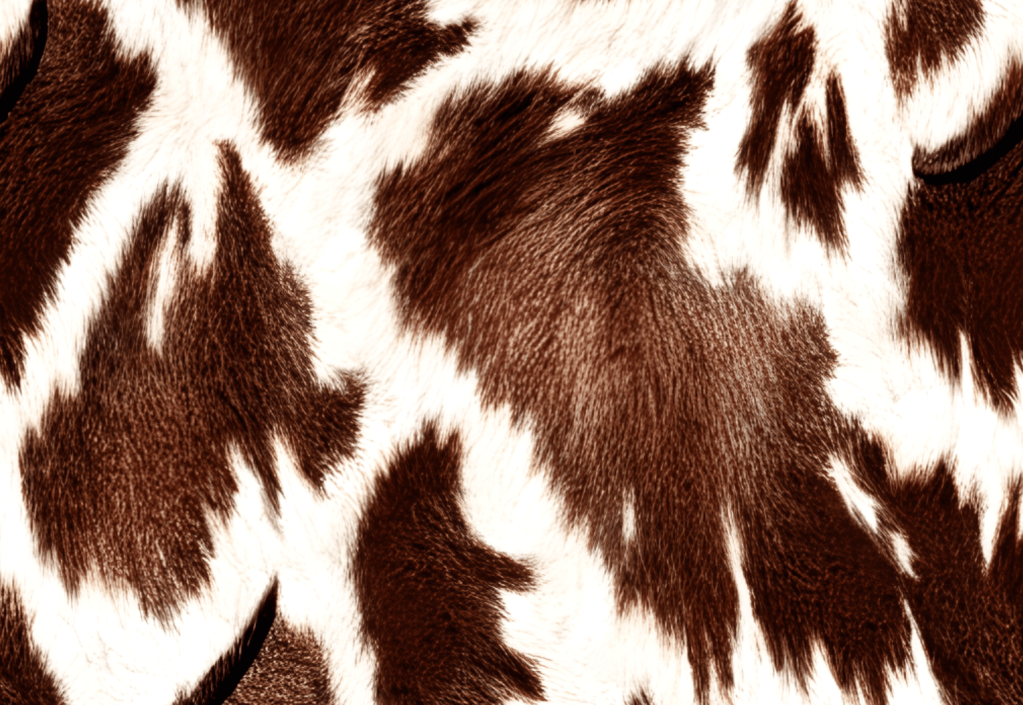
I see cows. From my living room window, I see cows. Although I was born in rural Western North Carolina, I have lived in high-rise condo buildings for more than three decades. Often, I would correlate the heights of my success with the building’s elevation: the 12th floor in Louisville, the 17th floor in St. Louis, and the 28th floor in Minneapolis. When the COVID-19 Pandemic occurred, I was on the top floor of a downtown Raleigh building, and, for the first time in my adult life, I felt confined. My partner and I circumnavigated this feeling by escaping the urban landscape and moving to a former tobacco farm in Eastern North Carolina. Now, I no longer look out my window and see people walking to shops, bicyclists dodging in and out of traffic, or the chiaroscuro of buildings lining the streets. I am grounded in a single-family home, and from the living room window, I see cows.
My daily bovine observation is not too far removed from my childhood in Hendersonville, North Carolina. The bucolic mountain town boasted an annual Farm City Day where crops and livestock would line Main Street, displaying apples and pigs in front of Justus Pharmacy, Country Kitchen, or Carolina Theater. My mother, an interloper to the Western North Carolina enclave, commented during the annual display, “We’ve seen ample farms; where’s the city?”

My mother, like her mother and her grandmother, needed the city. She needed to meander through a museum, wistfully eying colorful hues splattered on a canvas. She needed long luncheons where linen tablecloths were the foundation for ambrosia and cucumber sandwiches. Most importantly, she needed to spend time in a place where others understood the joy of a bouclé jacket, the feel of a cashmere sweater, the importance of a silk scarf, and the satisfaction of a well-formed Ferragamo. She needed a department store, and the local JC Penney would not suffice. She needed Ivey’s or Rich’s. When the 1980s unleashed Atari and MTV and her only child put up posters of David Bowie and Culture Club, she knew I would need the city too.
We began regular pilgrimages to the most sacred shopping destinations suitable for daytrippers: Greenville and Charlotte. About every six weeks, we would get up early on Saturday morning and, wearing carefully curated sportswear, meticulously executed our travel. These trips corresponded with pivotal calendar events where sartorial choices were important: Weddings, Funerals, Holidays, and Summer Vacations. However, the pivotal annual event that always required new clothing was simply called “Back-to-School.”

Going to high school in 1985 was documented in popular television series and movies. Denise Huxtable and her siblings were fashionable role models when most Americans tuned in every Thursday evening to The Cosby Show. John Hughes’ celluloid take on the ordinary focused not on the worker but the high school teen, highlighting society’s class division with impressive soundtracks and inspirational style. Molly Ringwald and Anthony Michael Hall detailed our growing individualism and quest for autonomy in The Breakfast Club. We were the MTV generation who welcomed the advent of VCRs, Sony Walkmans, and the Apple Macintosh. Our school desks sheltered us during routine drills, preparing us for nuclear attacks, an ever-present and ambiguous threat. Our social consciousness tackled the bombing of Black people in Philadelphia, global starvation focused on Africa, and our first pandemic, AIDS. Androgyny and sexuality fueled short films that now accompanied our popular music as we danced to Pete Burns, Boy George, and Annie Lennox. Prince fueled our funk and fashion with paisley-infused beats. The Iran-Contra Affair, Unabomber, airline crashes, and the New Coke shaped society’s understanding of the excess and absurdity of the Reagan era. The world of progress was moving quickly, and everyone from Phylicia Rashad to David Lee Roth suggested we navigate this landscape with panache. Taking my social cue from culture, I chose to navigate the fall of 1985 in a cowhide detailed bomber jacket from Guess by Georges Marciano.
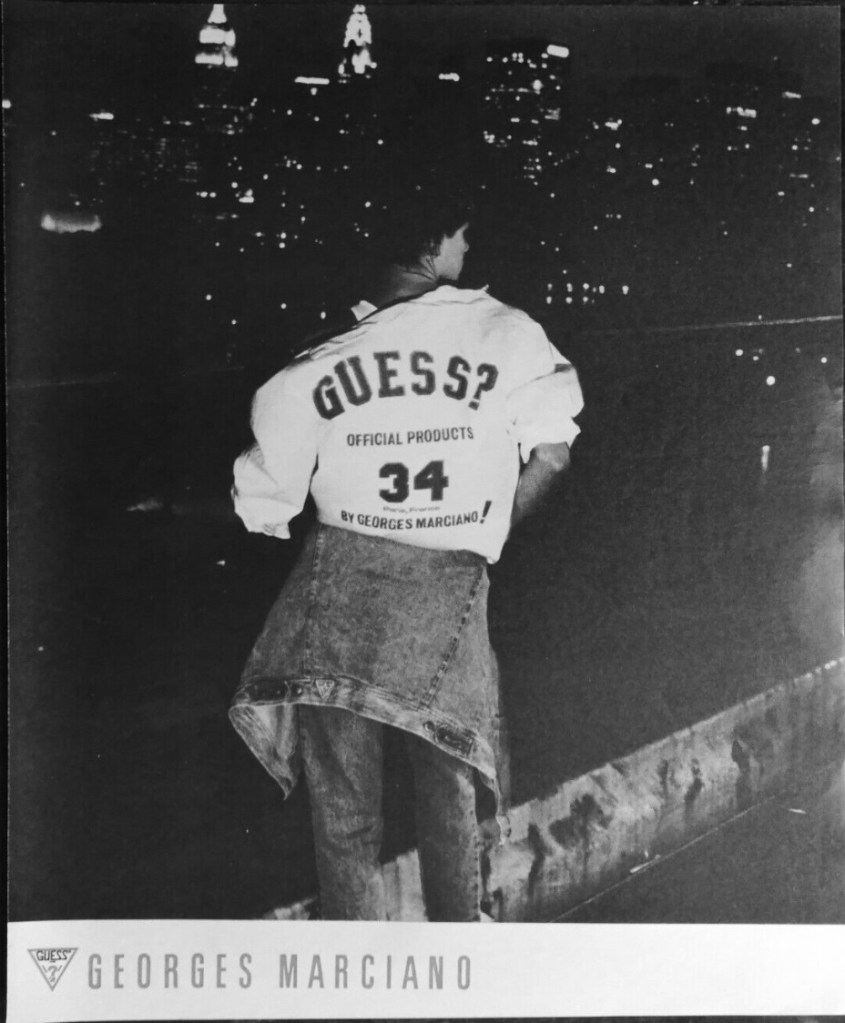
In the late 1970s, the Marciano brothers emigrated from the south of France, hoping to combine a European sensibility with the American Dream. Nothing screams Americano louder than blue jeans. From James Dean in Rebel Without a Cause to the cover of Bruce Springsteen’s Born in the USA, denim became synonymous with the sexuality and vitality of young Americans. The brothers Marciano formed Guess in 1981. Embracing the relaxed aesthetic of Southern California, Georges Marciano designed softer, form-fitting jeans that transformed denim. His three-zipper Marilyn jeans sold out at Bloomingdale’s in a few hours. Exposed button flies, lighter stone washes, and the strategically placed triangle logo on the right back pocket catapulted Guess into popular discourse. Within a few short years, Guess was in upscale department stores as an anchor of burgeoning young women and men departments with price points beginning at $65.00 (currently, this is equivalent to $185) for a basic jean.

By 1985, Guess supplied the wardrobe for one of the biggest summer blockbusters, Back to the Future. Michael J. Fox’s portrayal of Marty Mcfly skateboarded across cinema screens during a record-breaking movie summer, earning the film more than $388 million in revenue. In short, many people saw this film, and many of those people were American teens. Contemporary Marty epitomized 1980s style with his slim-fitting jeans in a soft and blue hue. His loose-fitting plaid shirt layered over the perfect cotton tee, held in place with suspenders. The pièce de résistance was Georges Marciano’s interpretation of the jean jacket. Opting for a bomber style, the jacket featured traditional blue denim at the shoulder and collar with contrasting gray denim on the sleeves and body. The shell was lined with a light paisley print that could be revealed as the sleeves were rolled. With attention to detail, a two-tone wash, and a popped collar, Marciano had secured his denim jacket’s cinematic importance. The timing was also critical as Guess would expand its men’s business in the fall of 1985, and one of the first offerings would be the denim jacket featured in Back to the Future.
By the time the Guess jacket made it to department stores, it was offered in four variations. The original, the jacket’s shoulder and collar in either white leather or red leather, and a unique version where the collar and shoulder were detailed with cowhide. I opted for cowhide. My back-to-school jacket would be the Guess denim jacket detailed with cowhide. Humans have been wearing animals, from tanned hides to practical furs, for millennia. The elite of the ancient Near East adorned themselves with horns and skins, expressing the connection between the animal kingdom and the divine pantheon. Royalty from around the globe have decorated their palaces with animal rugs and trophies. Cattle ranchers exploring the American West fashioned chaps from skins and hides to protect their legs from cacti and prevent wear from their pants. Couturiers from Dior to Schiaparelli regularly utilized furs, prints, and skins in their couture and prêt-à-porter. Street styles from flower children to punks to b-boys wore zebra, cheetah, and snakeskin prints to express their belonging and individuality. I knew none of this in 1985. I just wanted to be cool and wear something nobody else would wear.
Cool and unique will always be a factor in fashion.
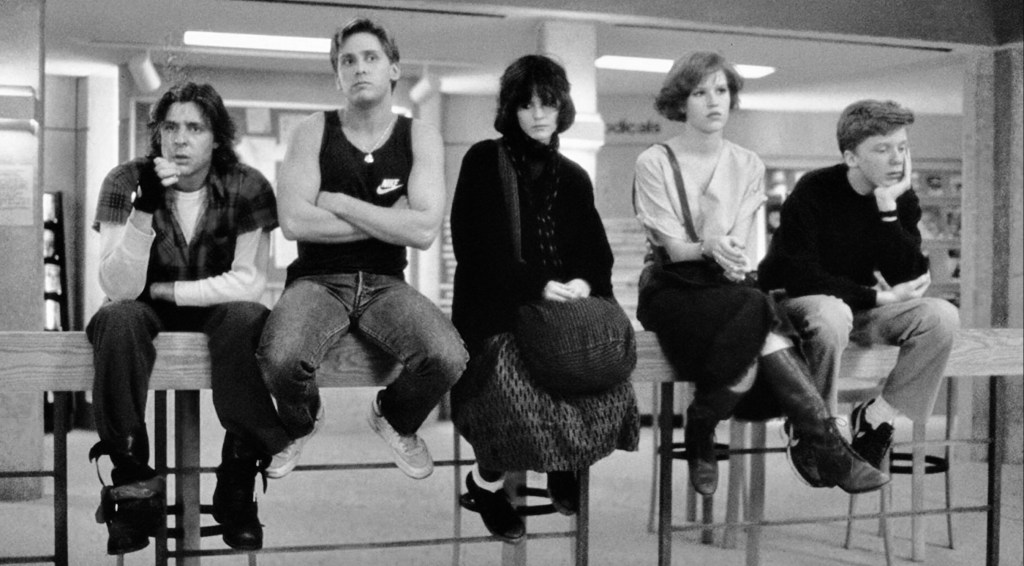
Looking cool was critical to a high school student in the 1980s. Before the advent of school uniforms and omnipresent athletic wear, students used their clothes to express their individuality. Individuality was critical in an American education system prone to producing an existential crisis rather than concerned citizens. Students were more worried about their lives during nuclear war than a government mass-producing nuclear missiles. We focused on our individual efforts to send food to Africa while being oblivious to the market forces stifling development on the continent. We could sing hopefully with Sting about the Russians loving their children, but we dance vigorously with Madonna about being touched for the very first time. With every step, we thought of ourselves, encouraged to express our sole thoughts while sitting neatly in rows digesting a uniform curriculum. Our understanding of the political machine was delayed because we were discovering a world with imperfections. We were discovering we had imperfections, and navigating an imperfect world took precedence over any ideology. We hid, disguised, and avoided facing these flaws with style. An oversized sweater with acid-washed jeans and colorful sneakers may not eliminate our inadequacies, but it was a fun distraction. We were solipsistic, and we looked good while doing it.
My cowhide-trimmed Guess jacket was the talk of Hendersonville High School during the fall of 1985. At the first sign of cool weather, I wrapped myself in the bomber, pairing it with the stripes, plaids, and paisleys that governed my closet. The jacket made an entrance in the pizza parlor after the Friday night football game. I wore it, collar popped while writing stories for the school newspaper. The jacket was a key piece in ensembles for school dances, debate tournaments, and the church youth group. Did I understand the critical intersection of 1980s excess and socioeconomics with the fantasy of an American Dream of going west envisioned by Jewish immigrants from Marseilles? No way. I just knew that I could be stopped by cheerleaders, nerds, jocks, geeks, and dweebs saying, “Dude, cool jacket.”
In the fall of 1987, I attended a theatre competition, entering the room in my favorite jacket and flanked by my fellow thespians. The Brothers Marciano designed a piece that lasted more than a season, a rare entity in fast fashion. Back-to-school shopping needed not to include a new coat since I was content in an imperfect world with an almost perfect jacket. I hung the jacket in a locker and began readying myself for the one-act play we would perform.
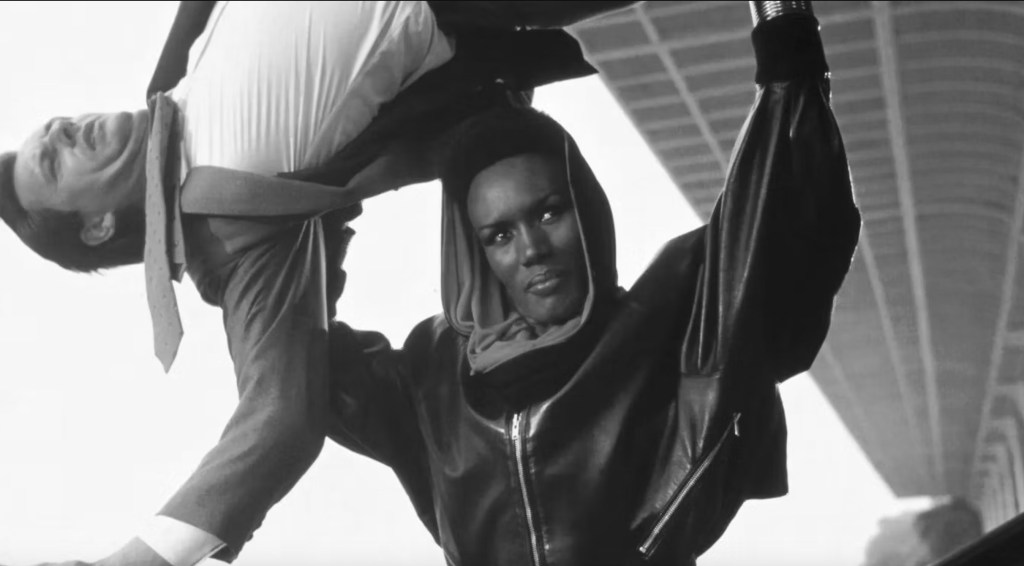
Theatre was a balm for any high school student with a proclivity for reading Oscar Wilde and dreaming of Rob Lowe. In our world of individuality and self-expression, being different had very acceptable forms. Being gay subverted the norm in a threatening way no 15-year-old could comprehend. Sexuality and pop culture were as confusing as our imperfect world. Grace Jones told us she was not perfect while flawlessly blending the masculine and feminine in music and movies. George Michael’s image was as soft, forceful, and dynamic as his vocals. Queer characters in films, if not dying of AIDS or violence, were severely isolated if not beaten. The material world looked like a vast spectrum of gender identities and sexuality. In reality, it was a brash reminder to color within the proscribed lines punctuated regularly with the taunt “faggot.” High school theater gave many of us a glimpse of how the world should be, and, for very brief moments, our sexuality wasn’t part of a flawed world but a celebrated trait.
Returning to the locker room, free of stage makeup and ready for reentry, I open the locker door to retrieve my jacket. It was gone. The empty space and cheap hanger taunted me. The American Dream, the cowhide shoulders, the fantasy of French and Jewish immigrants, the denim from celluloid history, the diversion from an imperfect world, and my chic stab at individuality were gone. Emptiness could never replace that. I faced the late September in naked arms, sullen, deflated, and hoping that the person who took the jacket would hear, “Dude, cool jacket.”

“You had what?” My partner was shocked at my account of the Guess bomber jacket during our morning litany of bovine observations. I smiled, thinking of the echelon of coolness stitched into the jacket more than 30 years ago. The temptation and immediacy of the internet are a welcomed invention of modernity. “Guess cowhide jacket” typed in a search engine quickly produced results. Within moments and a simple click, eBay sent the only offering of Marciano’s cowhide bomber.
Among the cache of boxes delivered on December 22nd was a plain offering from Sterling, Virginia. Ignoring the other parcels, I quickly tore into the package, discarding ripped cardboard and paper to reveal the content: The 1985 Georges Marciano for Guess Bomber Jacket in Soft Denim Trimmed in Cowhide. Slowly, I slipped on the jacket. My naked arms were now covered, and I could feel the longing, the fantasy, and the dream that sent the French brothers to California. The world, filled with flawed people and unjust systems, felt like there was hope. I entered the kitchen, where my partner typed away at the world of progress. He looked up, taking in the lines, the silhouette, and the popped collar covered in cowhide silently until he uttered three small words: “Dude, cool jacket.”
.
Sound + Vision: Dude, Cool Jacket (the 1985 Georges Marciano Edition)
- Axel F, Axel Faltermeyer
- Smooth Operator, Sade
- Cheri Cheri Lady, Modern Talking
- One Night In Bangkok (U.S. Club Promo Long Version), Murray Head
- The Wild Boys, Duran Duran
- How To Be A Millionaire (Wall Street Mix), ABC
- Oh Yeah, Yellow
- Oh Sheila (12-inch Remix), Ready For The World
- Lovergirl (Special 12-inch Mix), Teena Marie
- A Love Bizarre, Sheila E.
- Dress You Up, Madonna
- The Perfect Kiss (Substance Edit,) New Order
- Can You Rock Like This, Run-DMC
- Opportunities (Ron Dean Miller and Latin Rascal’s Version), Pet Shop Boys
- Bring On The Dancing Horses, Echo & The Bunnymen
- Pop Life (Fresh Dance Mix), Prince & The Revolution
- Lay Your Hands On Me, Thompson Twins
- Voices Carry, ‘Til Tuesday
- I Can’t Live Without My Radio, LL Cool J
- Running Up That Hill (A Deal With God), Kate Bush
- Russians, Sting
- Sehnsucht, Purple Schulz
- Careless Whispers, George Michael
 The Last Boudoir in Angier
Leave a comment